Yes, a rain water test kit is essential for households that use collected rainwater. This guide highlights top options to help you quickly assess safety, hardness, pH, and contaminants. Ideal buyers include homeowners with rain barrels, families needing well water screening, and those who want a quick at-home check before cooking or drinking. The featured kits cover a range of parameters, ease of use, and value. The table below compares the five selected products at a glance.
| Product | Key Focus | Strips Included | Best For | Notes |
|---|---|---|---|---|
| Varify 17in1 Complete Drinking Water Test Kit | Comprehensive 17 parameters | 100 strips + 2 bacteria tester kits | Families needing broad screening for lead, bacteria, fluoride | Color-change system; quick results |
| 23-in-1 Drinking Water Test Kit for Home (VibeEsece) | 23 indicators including bacteria | 155 strips | Tap, well, city water; general home use | Fast color results in seconds |
| All-New 20 in 1 Drinking Water Testing Kit (Bestprod) | 20+ parameters; easy ranges | 120 strips | General home, well, and tap water monitoring | Clear range and easy-to-read guide |
| Varify Water Hardness Test Kit | Hardness (0-425 ppm / 0-25 GPG) | 150 strips | Hard water concerns in homes and appliances | Bright color chart for quick reading |
| 125 ct Drinking Water Test Strips (HOVIRAN) | 18 parameters including lead and metals | 125 strips | Comprehensive home testing on a budget | 3-step test with color chart |
Varify 17in1 Complete Drinking Water Test Kit

Best for households that want extensive at-home water screening in one kit. The Varify 17in1 tests 17 parameters, including chlorine, fluoride, lead, iron, and bacteria. The kit includes 100 strip tests and two bacteria tester kits to provide a comprehensive overview of drinking water safety. Suitable for well, tap, and city water used in homes and small offices. Caution: Ensure proper storage and follow color interpretation guidelines for accurate results.
23-in-1 Drinking Water Test Kit for Home (VibeEsece)
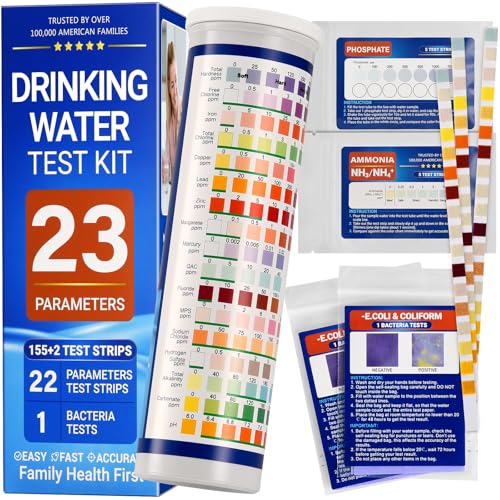
Best for households needing a broad overview of drinking water quality from various sources. This kit screens 23 indicators, including bacteria, hardness, pH, lead, iron, copper, chlorine, fluoride, nitrate, and more. It’s designed for tap and well water, making it ideal for families who prepare meals or formula and want quick results in seconds with an easy-read color chart. Consider this when you want a wide parameter range in one purchase.
All-New 20 in 1 Drinking Water Testing Kit

Best for users who want a straightforward, broad range without overcomplication. The 20-in-1 kit provides clear result ranges for common contaminants and emphasizes an easy-to-understand color-coded guide. It’s suitable for homes with varied water sources, including rainwater, and helps monitor changes over time. Choose this if you prefer a compact kit with clear guidance and practical ranges.
Varify Water Hardness Test Kit

Best for homeowners focusing on the impact of hard water on appliances, skin, and hair. This kit measures hardness levels (0-425 ppm / 0-25 GPG) with a large color chart that makes readings quick and accessible. It’s especially useful for evaluating whether a home water softener is working correctly or if scaling issues are present. Limitation: it covers hardness specifically, not a broad contaminant panel.
125 ct Drinking Water Test Strips (HOVIRAN)

Best for budget-conscious buyers needing a broad screening tool. This 18-parameter kit includes essential indicators such as lead, hardness, iron, copper, chlorine, nitrate, and more. The 125 strips provide long-term use and a simple 3-step test with a color chart. Consider this option if you want a cost-effective, multi-parameter test with straightforward interpretation.
Buying Guide
What should you look for in a rain water test kit?
Consider the breadth of parameters, ease of use, and the type of water you test most often (rainwater, well, or municipal). Kits with bacteria tests or E. coli detection provide greater safety assurance for drinking water. Look for color charts that are easy to read and clear instructions for timing and interpretation.
How many parameters do you need?
If you mainly need to screen for basic safety, a kit with 10-15 well-chosen indicators may suffice. For rainwater used for cooking or infant formula, a broader panel (20+ parameters) is preferred to catch potential contaminants that could affect health.
What about cost and practicality?
Bulk strip counts reduce per-test cost and are useful for ongoing monitoring. Simpler kits with rapid color results are convenient for quick checks, while more comprehensive kits help create a long-term water-tracking log for households with varying water sources.
Storage and shelf life
Follow storage guidelines to preserve strip accuracy. Exposure to humidity and heat can degrade strip potency, leading to inaccurate readings. Keep kits sealed and store in a cool, dry place as instructed by the manufacturer.
Best practices for interpreting results
Compare your results to the color chart or guide included in the kit. Record results over time to identify trends. If you notice consistently high levels of contaminants or unusual changes, consult local water quality resources or a professional for further testing.
What about rainwater-specific concerns?
Rainwater can accumulate contaminants from roofs, gutters, and storage systems. Testing helps determine whether filtration or treatment is necessary before use for drinking, cooking, or bathing.
FAQ
- Q: How often should I test rainwater? A: Test initially after setting up a rain collection system, then test seasonally or after heavy rainfall to monitor changes in water quality.
- Q: Which kit is best for a family with a well? A: A 20-in-1 or 23-in-1 kit with bacteria screening provides broader coverage for well water used for drinking and cooking.
- Q: Can I test for bacteria without special equipment? A: Some kits include bacteria testing strips or kits; use those if you need quick screening for bacterial presence.
- Q: Are color charts enough for accurate readings? A: Color charts are designed for at-home interpretation. For precise measurements or borderline results, consider lab testing for confirmation.
- Q: Should I test for lead in rainwater? A: If your roof or storage materials may contain lead or if your local environment raises concern, testing for lead is prudent.
- Q: What should I do if a test shows a high contaminant level? A: Follow kit instructions for next steps, and contact local health or water authorities for guidance on treatment or further testing.