Whether you’re stabilizing wood, degassing resin, or casting silicone, selecting the right vacuum chamber kit matters for bubble-free results. This guide highlights five compatible options, detailing who benefits most from each model and where they excel. The top picks balance capacity, build quality, and ease of use to suit hobbyists, woodworkers, and small studios alike. Below you’ll find a quick buying table, followed by in-depth product sections and a practical buying guide to help you compare features at a glance.
Summary table of selected products
| Product | Best For | Chamber Size | Vacuum Pump (CFM) | Seal Quality |
|---|---|---|---|---|
| VEVOR 3 Gallon Vacuum Chamber | Compact setups and beginners | 3 gal | 3.5 | Tempered glass lid; stainless steel |
| Orion Motor Tech 2 Gal Kit | Budget-friendly projects | 2 gal | 3.5 | Tempered lid; all-copper pump |
| VTG VOGTEN 5 Gallon Kit | Medium to large batches | 5 gal | 4.5 | Stainless steel; robust seal |
| BACOENG 5 Gallon Kit | Stable wood and volatile compounds | 5 gal | 4.5 | Tempered lid; durable gasket |
| VEVOR 5 Gallon Kit | Balanced capacity and features | 5 gal | 3.5 | Tempered glass; sturdy chamber |
VEVOR 3 Gallon Vacuum Chamber With Pump
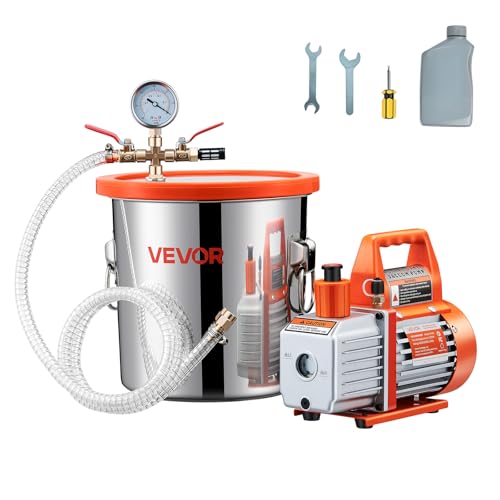
Best for compact projects and entry-level wood stabilization. This 3-gallon stainless steel chamber supports a 3.5 CFM pump, delivering an ultimate vacuum around 5 Pa. The tempered glass lid allows real-time observation of degassing without opening the chamber, and the built-in cooling system helps maintain stable performance during longer sessions. Suitable for small batches of wood, resin, or silicone degassing where space is limited. Caution: Smaller chamber volume means slower processing for larger pieces.
Orion Motor Tech 2 Gal Vacuum Chamber Kit

Best for cost-conscious buyers who want a complete degassing setup. This 2-gallon chamber includes a 1/4 hp vacuum pump and accessories for straightforward stabilization tasks, including wood, silicone, and resin. The all-copper motor supports efficient evacuation, while the tempered glass lid enables easy process monitoring. Best for smaller projects or when you’re testing degassing workflows on a limited budget. Limitation: Smaller chamber size reduces capacity for large items.
VTG VOGTEN 5 Gallon Kit

Best for mid-to-large projects and demanding degassing needs. The 5-gallon stainless steel chamber ships with a 4.5 CFM single-stage pump, delivering an ultimate vacuum around 5 Pa. The aluminum pump housing dissipates heat effectively, supporting longer degassing sessions. Ideal for larger resin batches and thicker woods, but heavier and bulkier to move. Tip: Consider bench space and weight when planning setup.
BACOENG 5 Gallon Tempered Glass Lid Kit

Best for durability and long-term use in wood stabilization and volatile compounds. The 5-gallon stainless steel chamber with a tempered glass lid features a reliable silicone gasket, and a vacuum gauge to monitor progress. Capable of achieving up to -29 inHg with relatively low noise. Choose this if you prioritize airtightness and ongoing reliability for repeated sessions. Limitation: Heavier build may require a sturdier workstation.
BACOENG 5 Gallon Tempered Glass Lid Kit

Best for high-seal reliability in steady degassing workflows. This chamber uses a 5-gallon stainless steel body with a tempered glass lid and orange silicone gasket for an effective seal. It supports vacuum up to 29 inHg and emphasizes long-lasting gasket performance, designed to withstand frequent use. Choose this for repeated wood stabilization cycles and consistent results. Note: The gasket is durable but may require occasional inspection for wear.
VEVOR 5 Gallon Vacuum Chamber Kit
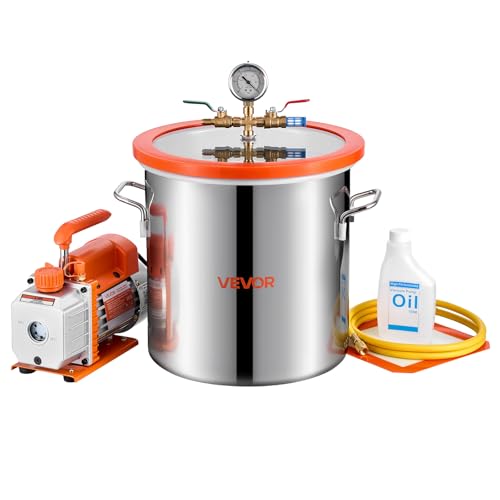
Best for a balanced mix of capacity and features. The 5-gallon stainless steel chamber pairs with a 3.5 CFM single-stage pump to reach an ultimate vacuum of about 5 Pa. A tempered glass lid allows clear observation, and the hose length and overall design support versatile placement. Suitable for larger wood pieces, resin degassing, and silicone work, but may be overkill for very small projects. Avoid this if you need ultra-lightweight portability.
Buying Guide: Key Considerations For Choosing A Wood Stabilizing Vacuum Chamber
- Project size and batch volume: Choose a chamber that comfortably fits your typical piece size and liquid volume. Larger volumes reduce the need for multiple runs but require more space and heavier equipment.
- Chamber material and seal integrity: Stainless steel chambers with tempered glass lids and reliable silicone gaskets provide durable seals and clear visibility during degassing.
- Vacuum pump specifications: Look for CFM ratings around 3.5–4.5 for effective debubbling. Single-stage pumps are common; two-stage pumps offer deeper vacuums but at higher cost.
- Vacuum depth and stability: A vacuum of around -29 inHg (approximately 5 Pa) is a common target for wood stabilization and resin degassing. Check for leak rates and gasket wear for long sessions.
- Ease of use and maintenance: Features like thermal protection, built-in cooling, oil viewing windows, and leak-proof designs reduce downtime and protect the equipment.
- Portability vs. capacity: If you need to move the setup often, lighter 3-gallon kits are easier to relocate, while 5-gallon kits suit larger projects but are heavier.
- Accessory inclusions: Kits with hoses, gauges, silencers, and installation tools save setup time and ensure compatibility with common workflows.
Frequently Asked Questions
- What vacuum level is best for wood stabilization?
– A vacuum around -29 inHg (about 5 Pa) is a common target for bubble-free stabilization and degassing, though exact levels depend on material and resin type. - Do I need a two-stage vacuum pump for stabilization?
– Two-stage pumps achieve deeper vacuums with greater efficiency but are more expensive. Many degassing tasks are effectively served by single-stage 3.5–4.5 CFM pumps. - Is a larger chamber always better for all projects?
– Not necessarily. Larger chambers handle bigger items and volumes but require more space and can take longer to purge completely. Choose based on typical piece size. - What maintenance is needed for these kits?
– Regularly inspect gaskets and lids for wear, check oil levels in the pump, and ensure hoses and fittings are leak-free to maintain performance. - Can these chambers degas silicone and epoxy as well as wood?
– Yes. Many kits are designed for degassing multiple volatile substances, including silicone resins and epoxies, in addition to wood stabilization.