Answering the question “which plastic weld solvent cement is best for my project?” this guide highlights five top options, chosen for clean seams, fast setup, and compatibility with common plastics like polystyrene and acrylic. Ideal buyers: hobby modelers, display case builders, and DIY crafters who want strong, clear bonds without residue. The following table summarizes the selected products for quick comparison.
| Product | Best For | Key Benefit |
|---|---|---|
| Plastruct Plastic Weld w/applicator 2oz Bottle | General Plastic Models | Immediate tacky solvent cement with integrated applicator |
| Berkland Acrylic Bonding Cement, 4 oz | Acrylic Sheets & Display Cases | Clear fast-setting bond for plexiglass and acrylic |
| Plastruct Plastic Weld Kit (Pixiss) | Comprehensive projects | Includes multiple applicators and swabs for precision |
| HH-66 Vinyl Cement 4 oz | PVC Vinyl & Tarps | Waterproof, flexible bond that dries clear |
| TAMIYA 87012 Plastic Cement | Model Building | Standard plastic cement widely used in kits |
Plastruct Plastic Weld w/applicator 2oz Bottle

Features: 2 Oz., Plastic Weld solvent cement with immediate tackiness. This product is best for small-scale plastic models and quick junctions where fast handling is needed. It provides a strong bond on typical modeling plastics with a controlled, minimal-waste application.
Best For: Hobby model builders who need a ready-to-use solvent cement with an integrated applicator for precise joints. Choose this if you want a compact bottle that reduces handling time and helps avoid spills.
Caution: The liquid cures quickly; work in a well-ventilated area and apply sparingly to avoid warping or excess cement seepage into fine details.
Berkland Acrylic Bonding Cement, 4 oz
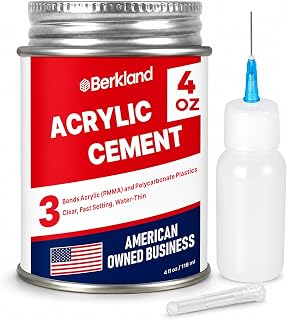
Features: Clear fast-setting cement suitable for plexiglass and acrylic sheets. Uses an applicator bottle for clean seams and reduced mess. This is best for acrylic display cases and small glass-like projects.
Best For: Projects requiring a transparent bond on acrylic surfaces. Choose this if you work with plexiglass or acrylic sheets and want minimal visible glue lines.
Caution: Do not use on porous woods or fabrics; ensure surfaces are clean and dry before applying.
Plastruct Plastic Weld Kit with Pixiss Accessories

Features: Includes Plastruct Plastic Weld alongside 3 Pixiss Needle Tip Bottles, a small funnel, and Pixiss swabs. This kit is designed for model building and repairs, offering multiple precision tools to control joint bonding.
Best For: Editors and builders who want a complete starter kit for detailed projects. Choose this if you value having extra tips and applicators to manage complex joints.
Limitation: The kit may provide more accessories than needed for ultra-simple joints; consider your project scope before purchasing a full accessory set.
HH-66 Vinyl Cement 4 oz
Features: Waterproof, flexible bond suitable for vinyl, PVC, and canvas. Dries clear and maintains elasticity, making it useful for pools, tarps, and boat seats.
Best For: Vinyl and PVC projects where a water-resistant bond is needed. Choose this if working with outdoor fabrics or pool equipment.
Caution: Not ideal for bare metal or certain specialty plastics; verify compatibility with your substrate before use.
TAMIYA 87012 Plastic Cement 20ml
Features: TAMIYA’s Plastic Cement 20ml is a standard option for model kits, designed to fuse polystyrene parts. It provides simple application and reliable bonding for typical model scales.
Best For: Model builders who follow kit instructions and prefer a straightforward solvent cement for common plastics. Opt for this if you want a familiar option used in many hobby kits.
Caution: Works best with clean, dry surfaces; avoid applying too thickly to prevent soaked joints and loss of fine detailing.
Buying Guide
What to consider when choosing plastic weld solvent cement:
- Material compatibility: Polystyrene, acrylic, PVC, and vinyl have different bonding requirements. Verify the solvent’s suitability for your substrate.
- Bond area and joint type: For small joints, bottles with precision applicators help control flow and minimize ooze. For large seams, a wider applicator or kit may be better.
- Drying and curing time: Faster-setting cements speed up projects but may require careful handling to avoid misalignment. Slower options offer more repositioning time.
- Clarity and aesthetics: Clear bonds are essential for display pieces. Acrylic-friendly cements reduce visible residue on transparent parts.
- Ventilation and safety: Always work in a well-ventilated area and follow product safety guidelines, as fumes can be strong with solvent-based glues.
- Accessory value: Kits that include extra applicators and swabs help with precision and cleanup on complex builds.
FAQ
- What is plastic weld cement best used for?
Plastic weld cement is designed to fuse plastic parts by softening surfaces for a strong bond, often used in modeling, display cases, and repairs.
- Is acrylic cement the same as plastic weld cement?
Not always. Some products are formulated specifically for acrylics, while others target polystyrene or PVC. Check the product description for substrate compatibility.
- Can I use these on vinyl or PVC surfaces?
Yes, but choose a cement labeled for vinyl or PVC to ensure a flexible, waterproof bond and to avoid cracking on joints.
- Do these solvents leave visible marks on transparent parts?
Clear-setting formulations minimize visible seams, but some products may still affect transparency if used improperly. Apply sparingly and test on a scrap piece first.
- What safety precautions are recommended?
Use in a well-ventilated area, wear gloves if needed, and avoid skin contact. Read the label for specific safety instructions.