Choosing the right 0.45 micron membrane filter depends on your sample type, chemistry, and testing method. This guide highlights five well-regarded options that cover syringeless disc filters and ready-to-use papers, with materials ranging from MCE and nylon to PES and PTFE. Each option balances filtration efficiency, chemical compatibility, and handling convenience for typical water, beverage, pharmaceutical, and microbiological applications.
| Product | Brand | Diameter / Size | Key Feature |
|---|---|---|---|
| Membrane Solutions MCE Gridded Membrane Filter | Membrane Solutions | 47 mm | Gridded, sterile, ISO 9001 cert., 3.1 mm grid lines for colonies |
| Labfil Nylon Disc Membrane Filters | Labfil | 47 mm | Hydrophilic nylon, resistant to solvents, good for aqueous samples |
| Syringe Filters Hydrophobic Nylon 0.45 μm | zoomto | 25 mm | Hydrophobic nylon, high retention, Luer lock, tight sealing |
| PES Membrane, 0.45 μm | ftpuresci | 13 mm | Ready-to-use hydrophilic PES, rapid micro-filtration |
| Omicron Nylon Membrane Circle | Omicron | 90 mm | Hydrophilic nylon, suitable for HPLC solvent filtration |
Note: The selection above focuses on a mix of disc filters and syringe filters with 0.45 μm pore size, covering diverse lab workflows. Each product is suitable for general microbiological analysis, water testing, and sample preparation where a 0.45 μm barrier is appropriate.
Membrane Solutions MCE Gridded Membrane Filter

- Application: Mixed Cellulose Ester (MCE) membrane filters are inert and widely used in microbiological analysis of water, wastewater, cosmetics, pharmaceuticals, and beverages.
- Quality: Sterile gridded membrane filter with a naturally hydrophilic surface; suitable for colony counting and sterility testing; ISO 9001 certified.
- Grid Features: Clearly defined 3.1 mm grid lines to aid colony counting and reduce grid line inhibition.
The MCE option provides a compact, sterile disc with robust grid lines, ideal for laboratories performing routine microbial analyses and sterility checks where standardized counting is important.
Labfil Nylon Disc Membrane Filters
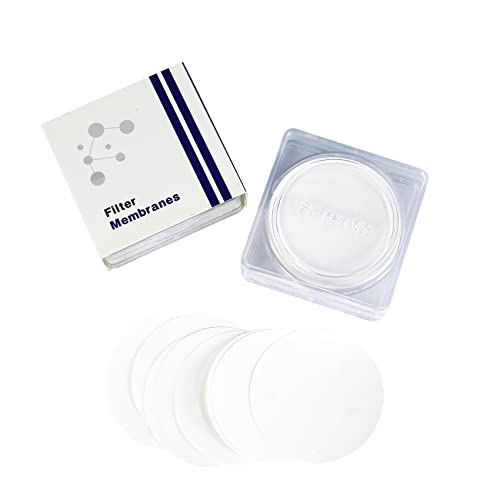
- Material: Hydrophilic nylon membrane resistant to a broad range of organic solvents; well-suited for aqueous samples.
- Compatibility: Binds proteins, which may limit use in protein recovery workflows.
- Use Case: Appropriate for general filtration, sample cleanup, and chromatographic preparation where solvent tolerance is needed.
Labfil’s nylon disc offers dependable hydrophilic performance with solvent robustness, making it a practical choice for routine filtration and sample preparation in chemistry and biology labs.
Syringe Filters Hydrophobic Nylon 0.45 μm

- Diameter: 25 mm disc; Pore size: 0.45 μm; 100 pieces per barreled pack.
- Material: Nylon hydrophobic membrane with broad chemical compatibility and high stability.
- Sealing: Premium polypropylene housing and hydrophobic membrane with a secure luer-lock connection to minimize leaks.
Hydrophobic nylon syringe filters are ideal for gas-free, solvent-rich sample filtration and quick, high-throughput workflows where a syringe-style setup is preferred.
PES Membrane 13 mm 0.45 μm

- Type: PES membrane, 13 mm diameter; ready-to-use hydrophilic nylon membrane with industrial-grade chemical resistance.
- Performance: Ultra-efficient micro-filtration with reliable pore structure at 0.45 μm.
- Applications: Suitable for a range of filtration tasks including chromatography sample prep and aqueous samples.
PES filters combine hydrophilicity and chemical resilience, offering compatibility with many biological and chemical workflows while maintaining filtration efficiency.
Omicron Nylon Membrane Circle

- Material: Hydrophilic nylon membrane with a plain surface and high wettability for consistent filtration.
- Durability: Heat-stable to autoclave cycles, suitable for sterilizable workflows.
- Use: Filtration of microbiological media, sera, and similar additives; also appropriate for HPLC solvent systems.
Omicron’s large-diameter nylon circle supports higher throughput and can be advantageous when filtering larger sample volumes or preparing media for microbiological testing and analytical workflows.
Buying Guide: Key Considerations When Selecting a 0.45 μm Membrane Filter
- Membrane material and compatibility: MCE, nylon, PES, and PTFE each offer different chemical resistances and sample compatibility. Hydrophilic membranes work well with aqueous solutions, while hydrophobic membranes suit organic-rich samples and solvent applications.
- Disc vs syringe filter: Disc filters (e.g., 47 mm or 90 mm) are ideal for vacuum or gravity filtration and high-throughput tasks. Syringe filters (often 13–25 mm) are portable and convenient for on-the-go or single-sample workflows, with Luer-lock options reducing leaks.
- Pore size precision and uniformity: A true 0.45 μm pore size ensures consistent retention of bacteria and particulates. Look for well-characterized products with defined pore structures and grid marks or clear labeling.
- Physical dimensions: Diameter and thickness affect filtration area, pressure limits, and compatibility with housings or custom rigs. Consider your filtration setup and required sample volume.
- Sterility and certifications: Sterile discs (e.g., ISO 9001) and validated processes help ensure sample integrity and regulatory compliance in clinical and environmental testing.
- Intended applications: Some membranes are optimized for colony counting, sterility testing, or chromatography prep. Match the membrane type to your primary analysis workflow to maximize performance.
- Cost and availability: For routine work, balance unit cost with filter performance and batch consistency. Bulk packs often provide better value for high-volume labs.
These factors help ensure you pick a 0.45 μm membrane filter that aligns with your sample matrix, analytical method, and workflow requirements, while maintaining accuracy and reliability across multiple runs.