When managing surgical drains and wound sites, 4×4 split drain sponges provide quick, stable dressing changes with a secure fit around tubing. These sterile, 6-ply gauze pads are designed to absorb drainage while cushioning surrounding tissue. This guide highlights five widely used options, outlining their key features, suitability for different drains, and practical considerations for selecting the right product for wound care teams and patients.
Summary of featured products:
| Product | Brand | Size & Ply | Notable Feature |
|---|---|---|---|
| McKesson Sterile Drainage Sponges 4×4 Inch (100 Sponges) | McKesson | 4×4″, 6-ply | Pre-slit, fits around drains |
| McKesson High Absorbency Split Gauze Sponges 4×4 | McKesson | 4×4″, 6-ply | High absorbency, pre-slit |
| Vakly Split Drain Sponge Gauze 4×4 (50 Pack) | Vakly | 4×4″, 6-ply | Pre-cut slit, sterile |
| McKesson Sterile Drainage Sponges 4×4 Inch (50 Sponges) | McKesson | 4×4″, 6-ply | Pre-slit, post-op use |
| Medline Non-Woven Sterile Drain Sponges 4×4 | Medline | 4×4″, 6-ply | Fenestration hugs drain tubes |
Note: Product variants vary by packaging counts and exact sleeve configurations. Always verify sterility and compatibility with your clinical protocols before use.
McKesson Sterile Drainage Sponges 4×4 Inch (100 Sponges)

Designed for surgical drain management, these 4×4 sponges provide coverage around JP, Penrose, and other drains. The 6-ply construction delivers reliable absorption while the pre-cut slit secures around tubing, reducing dressing changes and stabilizing the setup. Suitable for post-op care, the product aims to streamline aseptic handling and patient comfort. The packaging supports bulk use in clinical settings, aiding inventory management for hospitals and outpatient centers.
McKesson High Absorbency Split Gauze Sponges 4×4
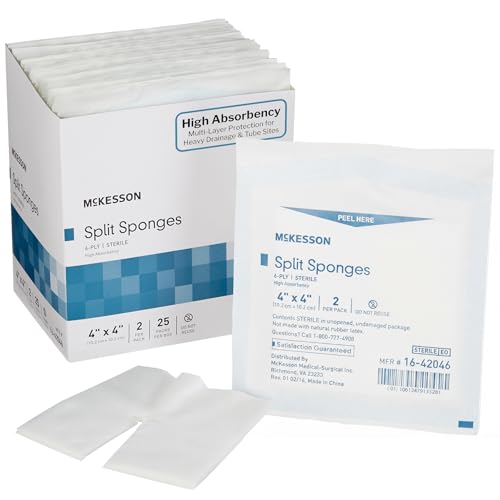
These 4×4, 6-ply sponges offer high absorbency for heavy drainage at tracheostomy sites, PEGs, and chest drains. The center slit is designed for easy placement around tubes and catheters, allowing quick dressing changes. The skin-friendly non-woven blend softens contact with delicate skin while providing cushioning. Clinicians may appreciate the balance between absorbency and ease of application, particularly in high-drain scenarios where rapid changes are needed to maintain a dry wound environment.
Vakly Split Drain Sponge Gauze 4×4 (50 Pack)

These 4×4, 6-ply sterile pads feature a pre-cut slit, designed to wrap easily around drains, IV lines, or tracheostomy sites. The fenestrated design helps the gauze lie flat and resist wrinkles, aiding consistent coverage. Packaged in sterile pouches, they are suitable for aseptic handling in busy clinical environments. The included materials are designed to reduce discomfort during dressing changes while maintaining effective drainage management.
McKesson Sterile Drainage Sponges 4×4 Inch (50 Sponges)

This McKesson option focuses on post-op wound management with a 4×4 size that cushions around drains and tubing. The pre-cut slit design helps prevent the need for cutting or tearing during dressing changes, supporting quick, sterile application. It is well-suited for Jackson-Pratt and Penrose drains and complements standard postoperative protocols by reducing dressing disruption while maintaining a clean environment around drain sites.
Medline Non-Woven Sterile Drain Sponges 4×4

Medline’s 4×4 drain sponges emphasize fenestration that hugs drain tubes tightly, helping keep the site drier. The 6-ply rayon/polyester fabric provides strong absorbency with a lighter lining, supporting prolonged drainage management. The pre-cut sponge design eliminates the need for sterile scissors, saving nursing time and minimizing handling. This option aligns with workflows that value efficient dressing changes alongside reliable protection for tube sites.
Covidien 6242P Dermacea Drain Sponge (Pack of 50)

Covidien’s Dermacea drain sponge presents a pre-cut notch design that conforms around drains, catheters, chest tubes, IVs, and tracheostomies. The sterile sponge is nearly lint-free, an important factor for reducing foreign particle contamination at wound and drain sites. It supports precise application in devices requiring flexible, intimate contact with the skin, while maintaining a clean, aseptic field for dressing changes.
Other options in this category share similar 4×4 dimensions and 6-ply construction, but may differ in fenestration, slit design, or packaging. When selecting, clinicians should consider drain type, anticipated drainage volume, dressing-change frequency, and patient comfort. The compatibility with tubing size and the need for quick, aseptic changes are essential factors in achieving consistent wound management outcomes.
Buying Guide: Key Considerations For 4×4 Split Drain Sponges
- Drain compatibility: Ensure the sponge has a center slit or fenestration that accommodates JP, Penrose, chest tubes, IV lines, or feeding tubes without tearing or folding.
- Ply and absorbency: A 6-ply construction offers strong absorbency for moderate to heavy drainage. Assess whether your setting requires high absorption or more lightweight coverage.
- Material and skin safety: Look for soft, skin-friendly non-woven blends to minimize irritation, especially for sensitive skin around prolonged dressings.
- Sterility and packaging: Choose sterile, peel-down or pre-packaged options to support aseptic handling and minimize infection risk.
- Ease of application: Pre-cut slits simplify placement around tubes, reducing procedure time and patient discomfort during dressing changes.
- Cost and inventory: Consider packaging counts (e.g., boxes of 50 or 100) and how often you replace dressings in your workflow, balancing cost with clinical need.
- Clinical setting: Hospitals, clinics, and home-care environments may favor different packaging and sizes. Align product choice with your care pathway and staffing capabilities.
- Regulatory and compliance: Verify that products meet applicable medical device standards and institutional approvals to ensure safety and traceability.
In summary, 4×4 split drain sponges deliver a practical balance of absorption, stability, and ease of use across various drainage scenarios. When selecting, prioritize drain types, site temperature and moisture, and how quickly dressings can be changed without compromising patient safety.