Looking for reliable 5 inch dust collector fittings to connect your main dust line to 4 inch hoses or tools? This guide highlights five top options that balance durable construction, smooth airflow, and easy installation. The best picks suit different workshop needs—whether you want a simple reducer, a versatile Y-branch, or a compact adapter for tight spaces. Use this overview to choose the right fittings for connecting main lines to smaller hose sizes, optimizing suction, and expanding your dust collection system.
The following table summarizes the featured products, including the type of connection, material, and best-use scenario. Use it as a quick-reference before diving into the detailed sections.
| Product | Connection Type | Material | Best For |
|---|---|---|---|
| 5″ to 4″ Dust Collection Reducer Adapter | 5″ OD to 4″ OD reducer | PETG | Low-profile transitions in carpentry setups |
| POWERTEC 70170 5″ to 4″ Reducer | 5″ main line to 4″ branch | ABS | General dust collection with multiple tools |
| Woodriver Dust Connection 5″ X 5″ X 5″ Y Fitting | Y (5″ to 5″ to 5″) | ABS | Smoother transitions to multiple tools |
| Hon&Guan 5 Inch Duct Connector | 5″ duct connector flange | ABS | DIY installations and wall/ceiling ducts |
| Big Horn 11508 5-Inch By 4-Inch By 4-Inch Y-Adapter | 5″ main line to dual 4″ branches | ABS | Branching to multiple tools with better suction |
5″ to 4″ Dust Collector Reducer Adapter

- Features: Reduces 5-inch hoses to 4-inch flex hoses for secure transitions. Durable PETG construction aims for reliable connections in workshop dust management.
- Best for: Woodworkers needing a simple, low-profile reduction between a 5″ main line and 4″ tools or hoses; ideal where space is limited.
- Why chosen: The tapered, smooth-flow design minimizes turbulence, preserving suction as air moves from larger to smaller diameters.
- Caution: PETG may be less rigid under heavy force; handle carefully to avoid cracks during assembly.
POWERTEC 70170 5” to 4” Reducer Dust Collection Fitting
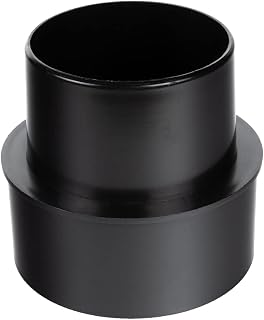
- Features: 5″ OD to 4″ OD reducer in black ABS. Designed to connect a 5″ main line to a 4″ branch line or to 4″ ID standard hoses.
- Best for: Shops with multiple machines where a single main line feeds several 4″ hoses; compatible with various hoses and planers.
- Why chosen: ABS plastic provides a sturdy, durable fit while remaining lightweight for quick installations.
- Caution: Ensure proper clamps and seals to prevent air leaks at the connection points.
Woodriver Dust Connection 5″ X 5″ X 5″ Y Fitting

- Features: Y (wye) configuration with all ends at 5″ nominal OD. ABS material supports multiple branch connections with a single main line.
- Best for: Workflows requiring smoother transitions to two or more 5″ branches; helps reduce turbulence compared with T-fittings.
- Why chosen: A smoother Y-branch can improve suction distribution across connected tools.
- Caution: All ends are 5″ nominal; verify hose IDs to ensure proper fit with your 4″ systems if used in tandem with reducers.
Hon&Guan 5 Inch Duct Connector

- Features: ABS 5 inch duct connector flange; easy to install by drilling holes and securing with clamps. Outside diameter is 122 mm.
- Best for: DIY and trade setups where a sturdy, wall- or ceiling-mounted duct connection is needed to tie into a central dust system.
- Why chosen: The flange design supports secure mounting and a clean, tight seal to minimize leaks.
- Caution: Ensure compatibility with your existing ducting size and check for proper clearance around mounting surfaces.
Big Horn 11508 5-Inch By 4-Inch By 4-Inch Y-Adapter

- Features: Connects a 5” main line to two 4” branches. Angled Y-shape offers smoother turns than a 90-degree T-fitting and reduces clogs.
- Best for: Expanding a central dust line to two workstations or tools while maintaining strong suction and flow.
- Why chosen: The angled design helps maintain airflow efficiency when branching off, aiding in reduced buildup at corners.
- Caution: ABS construction is robust but ensure proper alignment during installation to prevent leaks at joints.
Buying Guide: Key Considerations for 5 Inch Dust Collector Fittings
When selecting 5 inch dust collector fittings, consider the following to optimize suction and airflow while avoiding leaks and clogs.
Material and Durability
Most options use ABS or PETG plastics. ABS offers rigidity and impact resistance, good for heavier-duty setups. PETG can be more forgiving in curved transitions but may require careful handling to avoid cracks during install.
Connection Type and Airflow
Reducers are ideal for transitioning from a larger main line to smaller hoses, while Y-fittings distribute airflow to multiple tools with smoother turns. Avoid sharp right-angle transitions that create turbulence and reduce suction.
Compatibility and Fit
Verify nominal vs actual diameters. Some fittings list 5″ nominal OD but may match 5″ ID hoses or 4″ hoses in various configurations. Check hose IDs and ID/OD compatibility before purchasing.
Installation Considerations
Look for fittings with easy mounting options, secure clamps, and clear sealing surfaces. Some products are designed for wall or ceiling mounting, while others are meant for inline installations between hoses and ductwork.
System Expansion
If you plan to grow your dust collection network, prioritize Y-adapters and multi-branch fittings that can feed additional tools without replacing existing components.
Performance Trade-offs
Reducers and Y-fittings can impact static pressure differently. A smooth taper minimizes turbulence, whereas multiple branches may introduce modest pressure losses if not balanced across the system.
Frequently Asked Questions
- What is the purpose of a 5″ to 4″ reducer in a dust collection system? It allows connecting a larger main line to smaller hoses or tools, maintaining suction while adapting to different tool ports.
- Are Y-fittings better than T-fittings for dust collection? Yes, Y-fittings typically offer smoother airflow and less turbulence when branching to multiple tools, improving suction distribution.
- What should I consider when choosing material for fittings? ABS is durable and rigid; PETG offers good chemical resistance and flexibility in some shapes. Choose based on your mounting needs and impact tolerance.
- How do I prevent leaks at fittings? Use appropriate clamps, ensure clean mating surfaces, and apply seals or gaskets where recommended by the manufacturer.
- Can I mix 5″ and 4″ fittings from different brands? Mixing brands is possible if the diameters match exactly (ID/OD), but verify compatibility to avoid leaks or poor airflow.
- Should I upgrade all fittings for better performance? Upgrading to high-quality, smoothly tapered reducers and well-designed Y-fittings can improve overall suction and reduce clogs, especially in larger workshops.