For facilities that demand reliable, touchless hand hygiene, choosing the right commercial automatic soap dispenser is essential. The following five models are designed for high-traffic restrooms and workspaces, offering large capacities, durable construction, and easy maintenance. This guide compares key features like installation options, battery power, and antimicrobial protection, helping facility managers select practical, cost-effective solutions that minimize downtime and waste.
| Product | Brand | Capacity | Key Feature |
|---|---|---|---|
| AIKE AK1205 Brushed | AIKE | 25 oz | Backplate installation and battery-powered |
| AIKE AK1205 Matte Black | AIKE | 25 oz | Dual installation with durable finish |
| AIKE AK1226S Black | AIKE | 33.8 oz | Tamper-resistant design and isolated button |
| AIKE 1100 ml Brushed | AIKE | 1100 ml | High-capacity, multiple dispense settings |
| anydry AD1220S Black | anydry | 34 oz | Tamper-proof top and long battery life |
AIKE AK1205 Brushed Stainless Steel, 25 oz

The AIKE AK1205 Brushed model is a wall-mounted, commercial-grade soap dispenser with a 25-ounce reservoir. It supports dual installation via a robust backplate for secure drilling or glue mounting, and it runs on four AA batteries for maintenance simplicity. A sealed waterproof cavity protects the battery area, ensuring long standby with minimal upkeep, making it suitable for busy restrooms and kitchens in offices, schools, and healthcare facilities.
Key points
- Commercial stainless steel construction for durability
- Backplate supports secure, versatile installation
- Battery-powered with waterproof housing
AIKE AK1205 Matte Black, 25 oz
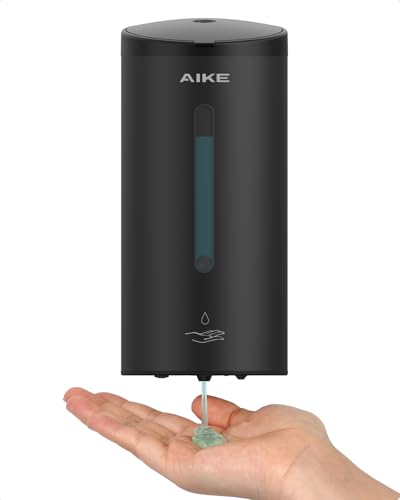
This matte black version shares the same robust backplate installation and four AA battery operation as the brushed variant. It’s designed to handle heavy foot traffic, with a clean, modern finish that blends into contemporary restrooms and kitchens. The unit’s waterproof battery cavity reduces maintenance downtime in damp environments while maintaining reliable soap dispensing.
Key points
- Matte black finish for aesthetic versatility
- Same secure installation and battery protection as other AK1205 models
- Low-maintenance design for high-traffic areas
AIKE AK1226S 33.8 oz, ABS Construction

The AK1226S combines a larger 33.8-ounce reservoir with a tamper-resistant design to prevent contamination and deter removal or tampering with the battery slot. It uses four AA batteries and emphasizes a protected battery area to extend service intervals in public or semi-public facilities. The unit is optimized for high-visibility public spaces where reliability is critical.
Key points
- Tamper-resistant opening and isolated button
- Extended battery life with secure slot
- Reliable performance in busy public areas
AIKE 1100 ml Brushed Auto Soap Dispenser

This 1100 ml capacity model is designed for high-traffic environments and can dispense more than 500 times per refill, reducing maintenance visits. It features surface mounting with precise installation distances to the desk or counter, plus an adjustable soap supply range. The brushed finish provides a professional, durable appearance for commercial restrooms or shared workspaces.
Key points
- Large 1100 ml capacity for high-traffic use
- Adjustable soap output settings
- Surface mount with clear installation guidelines
AIKE Matte Black 1100 ml Dispenser

The matte black variant maintains the same 1100 ml capacity with a five-level adjustable soap supply from 0.5 ml to 2.5 ml per dispense. The unit is designed for high-traffic bathrooms and public areas, providing consistent dispensing performance and a clean, professional look. Installation distances remain aligned with other AIKE 1100 ml models for flexibility in various configurations.
Key points
- Matte black finish for uniform aesthetics
- Five-level adjustable dosage
- Suitable for large, busy facilities
anydry AD1220S Black, 34 oz

AnyDry’s AD1220S is a 34-ounce, wall-mounted, touchless dispenser designed for high-traffic restrooms and offices. It features a tamper-proof top and a secure battery box with four AA batteries required. The design focuses on reliability and security to minimize misuse and ensure consistent soap delivery throughout the day.
Key points
- 34 oz reservoir minimizes refills
- Tamper-proof top and secure battery access
- Optimized for high-traffic environments
Buying Guide: Key Considerations and Comparisons
- Capacity and refill frequency: Larger reservoirs reduce maintenance intervals in high-traffic areas, but consider the footprint and mounting requirements to fit your space.
- Installation and durability: Wall-mounted and backplate options provide flexible installation. Stainless steel or ABS housing affects long-term durability in damp or cleanroom environments.
- Power and maintenance: Battery-powered units offer ease of installation and relocation, but check battery life and the practicality of battery replacements in your facility’s workflow.
- Sensor and dispensing consistency: Opt for models with robust sensors and adjustable dosage to balance soap use and hand hygiene standards across different user groups.
- Security and tamper resistance: In public or semi-public spaces, tamper-resistant features and secured battery compartments help prevent vandalism and downtime.
- Finish and compatibility: Finishes like brushed stainless steel or matte black blend with existing fixtures and signage, contributing to a cohesive restroom design.
- Maintenance access: Look for models with simple screw-access battery boxes and easy cleaning, especially in environments requiring frequent sanitation.
- Cost of ownership: Consider initial price, battery replacement frequency, and refill costs when evaluating long-term value.
- Compliance and hygiene standards: Ensure dispensers meet local health and safety guidelines for restrooms and food-service areas where applicable.
These selections emphasize robust construction, large capacities, and reliable dispensing suitable for schools, offices, hospitals, and other high-traffic facilities. By weighing installation options, capacity needs, and security features, facility managers can optimize both hygiene outcomes and maintenance efficiency.