Answering your search intent, these garage dust collectors prioritize air cleanliness, ease of use, and compatibility with common shop tools. Ideal buyers include hobbyists needing portability, small shop owners seeking budget-friendly options, and professionals wanting reliable filtration. The following picks cover ceiling-mounted filtration, standalone units, and cyclonic separators to suit different garage setups. A quick summary table below highlights each product at a glance.
| Product | Best For | Key Benefit |
|---|---|---|
| DEWALT DWXAF101 Air Filtration System | Garage with overhead space | 2-stage filtration with HEPA; remote control |
| WEN DC3401 | Small-to-medium shop with mobility need | 12-gallon bag; mobile base |
| WEN DC3474 | Wall-mountable compact setup | 15-gallon bag; strong airflow |
| ALORAIR Puricare 1350 | Large garage with ceiling-hanging option | 360° intake; built-in timer |
| Dustopper Pro | Best budget cyclone separator | High separation efficiency to reduce filter use |
DEWALT DWXAF101 Air Filtration System
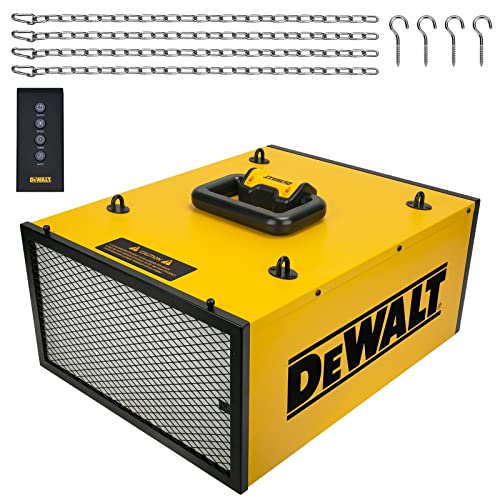
This 2-stage filtration dust collector uses a static cotton pre-filter plus an H11 HEPA filter to capture over 95% of 0.3 μm particles. It includes timer settings (1H, 2H, 4H, 8H) and a remote for convenient operation. Best for garages with ceiling or overhead mounting and users who want automatic air cleaning while away.
Who it’s best for: hobbyists or pros with ceiling space who want easy control and better air quality without frequent filter changes. Why selected: strong filtration and remote/timer features support longer, hands-off operation. Caution: larger footprint may require good ceiling clearance; ensure proper installation.
WEN Woodworking Dust Collector DC3401
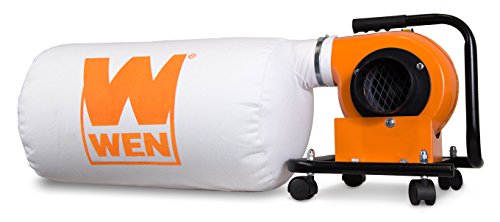
This system features a 5.7-amp motor and a 12-gallon bag, offering mobility via a built-in base handle. The 6-inch impeller moves up to 660 CFM with a 4-inch dust port for tool connections. Best for small-to-medium shops needing a compact, mobile dust collection solution.
Who it’s best for: weekend woodworkers who value portability and a simple bagged system. Why selected: strong airflow for its size and easy transport. Caution: larger shops may outgrow its capacity; consider a higher-CFM option if you run several tools simultaneously.
WEN DC3474 Dust Collector

This model uses a 7.4-amp induction motor and a 15-gallon bag with a 4-inch dust port. The design emphasizes wall mounting for accessible dust collection, keeping floor space clear while ensuring steady airflow of up to 600 CFM. Best for shops needing hanging or wall-embedded dust control.
Who it’s best for: garages with wall space and a desire to keep floor clutter down. Why selected: higher bag capacity and wall-mount capability improve workflow in compact shops. Caution: installation requires a sturdy wall mount; confirm wall strength before setup.
ALORAIR Puricare 1350IG

The 1050/1350 CFM air filtration system offers a 360-degree intake and an IR remote with timer control. It can be hung from the ceiling or placed on a workbench, making it versatile for larger garages. Best for: users needing strong, broad-area filtration and mobility. Caution: not California compliant; verify shipping restrictions before ordering.
Why selected: high airflow and 360-degree intake support wide coverage in bigger spaces. Choose this if you want flexible placement and long-run air purification between jobs.
Dustopper PRO Low-Profile Dust Separator

This low-profile separator is engineered to maximize dust separation before it reaches your vacuum. It fits standard 5-gallon buckets and includes high-flow 90-degree elbows for a smoother, less cluttered setup. Best for those seeking reduced filter and bag costs. Limitation: designed to work with vacuums, not as a standalone dust collector.
Who it’s best for: budget-conscious shoppers who want to protect their shop vacs and extend their filter life. Why selected: emphasis on separation efficiency helps maintain suction and cut long-term costs. Caution: verify compatibility with your existing vacuum and bucket size.
ALORAIR Puricare 1350
This 360° intake air filtration system with built-in ionizer is designed to remove dust and odors while improving air quality in woodworking spaces. It is not California compliant and includes timer control and a remote for easy operation. Best for: larger garages where comprehensive air cleanup is a priority. Caution: California shipping restrictions apply; confirm readiness for use in your area.
Buying Guide
- Filtration vs. Separation: Choose HEPA or high-efficiency filters for fine dust; cyclone/ separator units reduce dust before it reaches vacuums or bags.
- Space and Mounting: Ceiling-hung and wall-mount options save floor space; ensure structural support and clearance for installation.
- Airflow and Coverage: Higher CFM handles larger shops; match to tool usage and shop size to avoid underperforming systems.
- Power and Noise: Check motor amperage and noise levels; consider placement to minimize disruption in living spaces adjacent to the garage.
- Maintenance and Costs: Filter replacement frequency and bag costs affect long-term operation; devices that reduce particle load may lower ongoing costs.
Frequently Asked Questions
- What is the difference between a dust collector and an air filtration system?
– Dust collectors primarily remove debris from tool exhaust, while air filtration systems focus on cleaning general air (including odors and fine particles) in the space. - Is a ceiling-mounted system better than a portable unit for a garage?
– Ceiling-mounted options save floor space and can cover larger areas more evenly, but portable units offer flexibility for changing layouts. - Do I need a higher CFM for multiple tools running at once?
– Yes, higher CFM helps maintain airflow when several tools produce dust concurrently. Plan for peak usage. - Are there products not allowed in certain states?
– Some models explicitly note California shipping restrictions; verify local regulations before purchase. - How often should I replace filters?
– Replacement frequency depends on usage, dust type, and the system’s design; follow manufacturer guidelines for best results.