For any woodshop, a reliable dust collector reduces debris, protects tools, and keeps air quality high. This guide highlights five top options catered to different workshop needs—from compact setups to higher-capacity systems—so you can choose the best dust collector for your space. The listed picks are suited for hobbyists, small shops, and serious DIYers seeking better filtration, easier maintenance, and clearer work areas.
Summary of Selected Products
| Product | Best For | Key Benefit |
|---|---|---|
| DEWALT DXVCS002 Dust Separator | Small to mid-size workshops | High-efficiency cyclone separation, easy portability |
| WEN DC1300 Dust Collector | Budget-friendly, larger shops | 1,300 CFM with dual tool capability |
| DEWALT DXVCS003 10-Gallon Separator | Medium workshops needing more capacity | Stainless tank, high efficiency |
| DeWalt DWXAF101 Air Filtration System | Air quality focus, ceiling-mount flexibility | 2-stage filtration with remote control |
| WEN DC3474 Woodworking Dust Collector | Wall-mount option, compact spaces | 7.4-amp motor, mobile base |
DEWALT Dust Separator with 6 Gallon Poly Tank

The DEWALT DXVCS002 dust separator is designed for compact setups that still demand high efficiency. Best for smaller shops or hobby projects where space and budget matter, this unit pre-separates debris before it reaches the vacuum, reducing suction loss and filter wear. It supports 1-7/8″ or 2-1/2″ ports for compatibility with many vacuums. A stable four-caster base makes it easy to move around.
Who it’s for: ideal for DIYers and light workshop environments that want to protect their vacuum and extend filter life without sacrificing mobility. Better for: small to mid-sized spaces with single or light multi-tool use. Caution: capacity is limited to a 6-gallon tank, so very large dust loads may require more frequent emptying.
WEN DC1300 1,300 CFM Dust Collector

The WEN DC1300 delivers substantial air movement (up to 1,300 CFM) with a 50-gallon collection bag, making it suitable for mid-to-large workshops. It supports up to two tools via dual 4-inch inlets, enabling better dust collection for multi-tool setups. The vertical bag design allows easy emptying and straightforward maintenance. Best for: workshops that need higher throughput and simultaneous tool connections. Limitation: may require more space and a stable mounting area for optimal operation.
DEWALT DXVCS003 10-Gallon Stainless Separator

This stainless-steel version expands on the 6-gallon design with a larger 10-gallon tank for longer uninterrupted use. It features high-efficiency cyclone separation to capture chips and debris before entering the vacuum, protecting suction and filters. The four-caster base adds stability and mobility in busy shops. Best for: woodshops needing more capacity without stepping up to a full industrial system. Choose this if: you routinely process larger volumes of dust and chips per session. Limitation: heavier unit may require more effort to move when full.
DeWALT DWXAF101 Air Filtration System
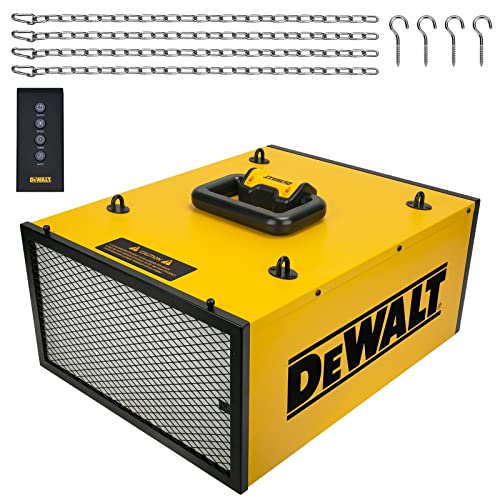
For air quality, the DeWALT DWXAF101 offers a two-stage filtration setup, including a cotton pre-filter and an H11 HEPA filter, capable of capturing a broad range of fine particles. It features multiple operating modes and a built-in timer with remote control for convenience. Best for: workshop spaces where air cleanliness is a priority, especially in enclosed or poorly ventilated areas. Limitation: designed primarily for filtration rather than comprehensive dust collection from tools; it complements a primary dust collector rather than replacing it.
WEN DC3474 Woodworking Dust Collector

The WEN DC3474 combines a powerful 7.4-amp induction motor with a 9-inch impeller, moving up to 600 CFM. It includes a 15-gallon collection bag and offers wall-mount capability for space-constrained shops. Best for: users who need a compact system with wall-mount flexibility and straightforward setup. Caution: lower air volume compared to larger DC models; choose this if space and easy mounting are primary constraints.
Buying Guide
- Shop size and layout: Measure available floor space and ceiling height. Choose a model with a compact footprint and, if possible, a mobile base for reconfiguration.
- Airflow needs: Target CFM relative to tools used. Multi-tool setups benefit from units with dual inlets or higher CFM ratings.
- Tank capacity vs. maintenance: Larger tanks mean less frequent emptying but heavier units. Balance capacity with portability.
- Filtration vs. collection: Use cyclone separators to protect vacuums and extend filter life. Add HEPA or fine filters when air quality matters.
- Noise and mounting options: Consider units with sound dampening and wall-mount or ceiling-mount options for small spaces.
- Compatibility: Ensure compatible ports (1-7/8″ or 2-1/2″) align with existing vacuums and tools.
FAQ
- What size dust collector do I need for a small shop? A compact model with 600–1,000 CFM and a 5–15 gallon tank is typically sufficient for hobbyist work and a few tools.
- Is a dust separator better than a traditional dust collector? Yes, a cyclone-style separator protects vacuum or main dust collectors by removing heavier debris before it enters the bag or filter, reducing maintenance.
- Can dust filtration systems replace a dust collector? Filtration systems improve air quality but usually work best alongside a primary dust-collection unit that handles bulk debris.
- How important is port size compatibility? Very important. Incompatible ports require adapters and can reduce suction efficiency if not matched properly.
- Should I prioritize mobility or capacity? If you frequently move between benches, mobility matters. If you process large volumes, prioritize capacity to reduce emptying frequency.
- Do accessories add real value? Yes. Hoses, fittings, and separators improve ducting flexibility and prolong filter life, especially in busy shops.