Answer: A ground water testing kit is best for homeowners and renters who want a quick, at-home check of essential contaminants and water quality. These kits help you assess hardness, lead, chlorine, pH, bacteria, and more, so you can decide whether you need treatment, a filtration upgrade, or professional testing. The top picks below are suited for well owners, households with aging pipes, parents monitoring for infants, and anyone seeking a broader overview of drinking water safety. The table summarizes the five chosen kits for easy comparison.
| Product | Brand | Key Focus |
|---|---|---|
| Bestprod All-New 21 in 1 Drinking Water Testing Kit | bestprod | 21 parameters; easy-to-read results |
| Varify 17in1 Complete Drinking Water Test Kit | VARIFY | 17 parameters; bacteria screening |
| All-New 23 in 1 Drinking Water Testing Kit | AESCULIX | 23 parameters; large strip set; E. coli option |
| HYCHEK 21 in 1 Drinking Water Kit | HYCHEK | 21 parameters; clear color chart |
| Water Test Kit 23-in-1 (VibeEsece) | VibeEsece | 23 parameters; fast color results |
Bestprod All-New 21 in 1 Drinking Water Testing Kit

The Bestprod 21-in-1 kit tests for common contaminants and water quality indicators, including hardness and lead, with easy-to-read results and a straightforward guide on the bottle. It is best for households needing a broad, at-home overview without complex steps. The kit emphasizes user-friendly use: add water, set a timer, and read results. Best for: small families or renters who want a simple, quick check before relying on a countertop filtration system.
Limitation: The kit’s results rely on color interpretation; cross-check if precise quantification is essential. Also, does not replace professional lab testing for legal or highly regulated applications.
Varify 17in1 Complete Drinking Water Test Kit

The Varify kit provides 17 essential parameters, including chlorine, fluoride, lead, iron, and bacteria testing, plus a dedicated bacterium testing capability. It is best for households seeking a more comprehensive screening and professional-grade quality control in a home setting. The color-coded strips simplify interpretation. Choose this if you want a broader view beyond basic hardness and pH.
Caution: The kit’s bacteria testing requires careful handling and adherence to included instructions to avoid cross-contamination. Not a substitute for clinical water safety testing in high-risk scenarios.
All-New 23 in 1 Drinking Water Testing Kit

This kit tests 23 parameters, including hardness, residual chlorine, pH, copper, iron, lead, and more, with a large 158-strip supply for ongoing monitoring. It’s best for households interested in long-term tracking and those who want an extended parameter list, plus an E. coli detection component for added reassurance. It supports ongoing water quality management over time.
Limitation: The larger strip set may require more storage space and careful organization to prevent misreads from expired strips.
HYCHEK 21 in 1 Accurate Drinking Water Testing Kit
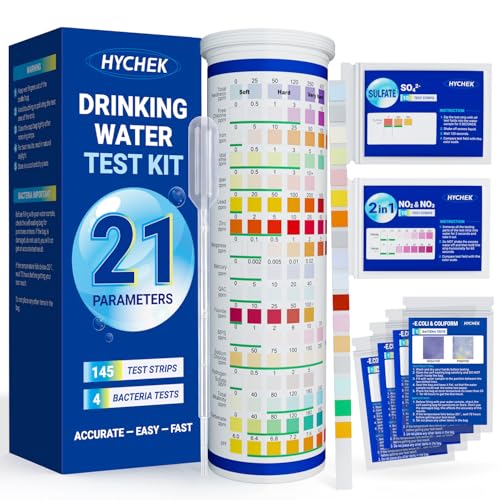
The HYCHEK kit delivers 21 parameters with a color-accurate chart and clear results. It also includes tests for coliform/E. coli, offering robust screening for home drinking water. Best for families seeking a balance of many parameters with dependable visual guidance. The three-step testing process is straightforward, reducing guesswork.
Caution: Color interpretation still depends on lighting; test in daylight or well-lit conditions for best accuracy.
Water Test Kit 23-in-1 (VibeEsece)
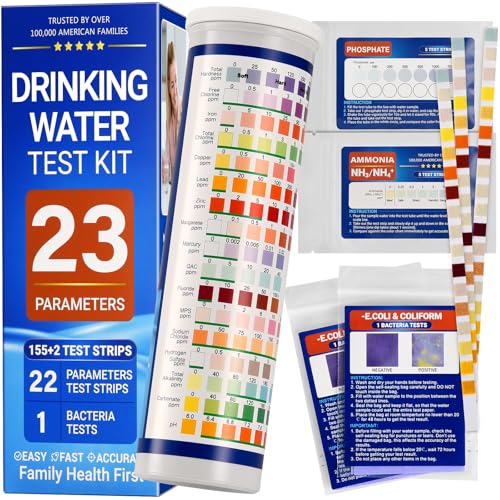
VibeEsece’s 23-in-1 kit covers a broad spectrum of indicators including hardness, lead, iron, copper, chlorine, fluoride, pH, and more, with fast color results. Best for households requiring quick screening with a comprehensive set of measurements. The kit is suitable for tap and well water before cooking or formula preparation.
Limitation: As with other strip-based kits, precise measurement requires careful color matching and control of lighting conditions.
TESPERT 16-in-1 Drinking Water Test Strips

TESPERT offers a 16-parameter screen with quick 30-second results. It emphasizes fast initial screening for well, tap, and city water. Best for households prioritizing speed and a broad but concise parameter range. It includes practical testing tips for best accuracy and reliable interpretation.
Note: It’s a screening kit; for regulatory or medical decision-making, confirm results with a professional lab test.
Safe Home DIY Bacteria in Water Test Kit

This kit focuses on detecting coliform bacteria, including E. coli, in water samples. It is best for households that want a dedicated bacterial screen in addition to general water quality tests. The kit is EPA lab-certified and made in the USA, offering confidence in its laboratory-backed approach.
Caution: Bacteria testing is sensitive to handling; follow sterilization and sample collection instructions precisely to avoid contamination.
API Freshwater Master Test Kit

The API Freshwater Master Test Kit is designed for aquarium use but also helps monitor five vital water parameters such as pH, high range pH, ammonia, nitrite, and nitrate. Best for aquarium owners and hobbyists who want precise chemical readings. It’s a practical pick when you’re actively maintaining a water system with living organisms.
Limitation: This kit is tailored to freshwater aquariums, so its parameter emphasis may differ from household drinking water kits. Use for its strengths in aquarium water management rather than home drinking water concerns.
Buying Guide
What should you test for in ground water?
Key parameters often include pH, total hardness, lead, copper, iron, nitrate, chlorine, fluoride, and bacteria/E. coli. Testing for these helps identify potential health risks, corrosion potential in pipes, and suitability for drinking and cooking.
How many parameters do you need?
For general home use, 7–12 parameters provide a solid baseline (pH, hardness, lead, iron, copper, chlorine, nitrate, fluoride, bacteria). If you rely on well water for family use or infants, a broader panel (15–23 parameters) adds reassurance, including E. coli detection and comprehensive bacterial screening.
Which kit is best for ongoing monitoring?
Look for kits with a larger supply of strips (e.g., 158 strips or more) and the ability to document changes over time. Large strip sets support monthly tracking and trend analysis, which is useful for wells or seasonal water changes.
What about accuracy and interpretation?
Choose color-chart kits with clearly labeled parameters and a consistent color scale. Lighting conditions affect color interpretation, so test in daylight or bright indoor light. Some kits provide a guide that matches color blocks to reading values for easier interpretation.
Safety and handling considerations
Follow all handling and disposal instructions. Bacteria tests require careful sampling to prevent cross-contamination. Keep test strips dry when not in use and store them according to the manufacturer’s guidelines.
FAQ
- What is the most important parameter to test for private well water? Lead, bacteria (E. coli), and nitrate are often prioritized due to potential health risks, followed by pH and hardness.
- Can I rely on a home test kit for drinking water safety? Home kits provide a quick screening and trend information, but they are not a substitute for professional laboratory testing in high-risk situations or regulatory contexts.
- How often should I retest my water? Monthly testing is common for wells with fluctuations; at minimum, test annually or after events like flooding or pipe repairs.
- Do strip-based tests give exact concentrations? They provide approximate ranges based on color matching; for precise values, send samples to a certified lab.
- What should I do if a test shows contamination? If contaminants are detected or suspected, consult local health authorities and consider professional testing and appropriate treatment solutions for your home.
- Are there kits that test for bacteria? Yes, several kits include bacteria/E. coli detection components, offering additional peace of mind beyond basic chemical parameters.