Answering the need for reliable, compostable liners, this guide highlights top kitchen bin liners that fit small to medium countertop bins and support home composting. Ideal buyers include: eco-conscious households seeking certified compostable bags, busy cooks who prioritize leak resistance, and apartment dwellers using compact bins. The following selections balance fit, certification, and strength to help you pick liners that reduce mess and maximize composting efficiency.
Summary of chosen products
| Product | Capacities | Certification | Best For |
|---|---|---|---|
| GreFusion Compostable Bags | 0.75–1.8 gal | BPI, ASTM D6400, OK Compost HOME | Best for very small to small countertop bins |
| ANECO 2.6 Gallon Bags | 2.6 gal | BPI, CMA, OK compost HOME | Best for medium countertop bins |
| UNNI 2.6 Gallon Bags | 2.6 gal | BPI, CMA, OK compost HOME | Best for everyday use in small kitchens |
| UFCOELPT 1.6 Gallon Bags | 1.6 gal | ASTM D6400, EN 13432 | Best with handles for mess-free disposal |
| TERRACOR 3 Gallon Bags | 3 gal | BPI, ASTM D6400 | Best for larger countertop bins |
GreFusion Compostable Bags 1.2 Gallon – Small Countertop Bin Liners

Best for: Small countertop bins, bathrooms, or car bin use. These bags fit 0.75–1.8 gallon cans and are designed to line most compact waste pails. They’re strong enough to hold kitchen scraps and coffee grounds without tearing and are certified compostable under major standards.
- Fits: 0.75–1.8 gallon bins; diameter ≤ 10″, height ≤ 11″
- Materials and certifications: ASTM D6400, BPI certified; OK Compost HOME
- Leak resistance: Bottom-integral forming minimizes leaks
Best for: Buyers who need a compact, certified option that works with very small bins in kitchens or bathrooms. Caution: Some users report sizing variability with non-standard bin shapes; verify your bin’s dimensions before purchasing.
ANECO 100% Compostable Waste Bags 2.6 Gallon (110 Count)

Best for: Medium countertop bins and everyday kitchen use. These bags emphasize compostability in home systems, breaking down into CO2 and biomass under appropriate conditions without leaving plastic residues.
- Size: 2.6 gal; 110 bags per pack (100 + 10 bonus)
- Materials and certifications: Home compostable; reduces plastic footprint
- Strength: Designed to hold typical kitchen scraps and wet waste
Best for: Those who want extra bags at a consistent price and prefer fully compostable liners. Caution: Some facilities require specific composting conditions for optimal breakdown; home composting varies by environment.
UNNI Compostable Trash Bags 2.6 Gallon, 100 Count
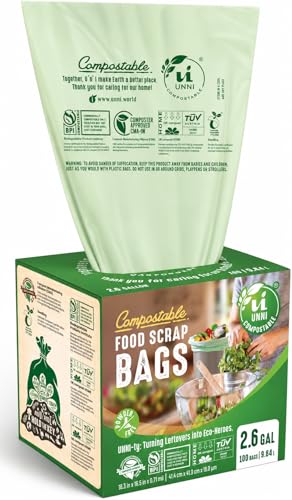
Best for: Small kitchen bins that require a sturdy, everyday-use liner. These 2.6 gal liners are independently certified, aiming for reliable compostability in home and municipal contexts.
- Capacity: 2.6 gal; 100 bags per roll
- Certifications: BPI, CMA, OK compost HOME
- Strength: 0.71 mil thickness provides daily use durability
Best for: Users prioritizing verified certifications and consistent performance in compact bins. Caution: Thicker liners may be less flexible in very tight bins; check fit before use.
UFCOELPT 1.6 Gallon Compostable Bags With Handles

Best for: Those who want a mess-free disposal experience with built-in handles. The 1.6 gal bags are designed for 6-liter countertop bins and provide an easy lift-and-tie option.
- Capacity: 1.6 gal; 55-pack with 10% extra
- Certification: ASTM D6400 and EN 13432
- Durability: Reinforced 0.63–0.7 mil thickness for wet scraps
Best for: Home users who value convenient handling and clear compostability standards. Caution: Handle ties may add a slight extra step in disposal for very fast routines.
TERRACOR 3 Gallon Compostable Bags

Best for: Larger countertop bins in kitchens, offices, or shared spaces. These 3-gallon bags fit standard 16.9″ x 17.7″ liners and meet ASTM D6400 with BPI certification.
- Size: 3 gal; 100 bags per roll
- Materials: Plant-based PLA and PBAT blends
- Certification: BPI, ASTM D6400
Best for: Environments needing bigger liners without sacrificing compostability. Caution: Larger bags may be unnecessary for very small bins; ensure your bin accommodates this size.
Buying Guide: How to Choose the Right Kitchen Compost Bin Liners
What size fits your bin?
- Measure your bin’s inner diameter and height. Pick liners labeled to fit within those dimensions to avoid gaps and leaks.
- For very small bins (0.75–1.2 gal), choose 0.75–1.2 gal liners for a snug fit and minimal waste.
What certifications matter?
- Look for BPI, OK compost HOME, and ASTM D6400 certifications. These indicate biodegradability under home or industrial composting conditions and safer disposal.
- EN 13432 compatibility is common for European standards and can be reassuring for international use.
Leak resistance and strength: when to prioritize thickness?
- 0.71–0.75 mil is typical for everyday kitchen scraps. If you have wet waste, consider bags with reinforced bottoms or thicker material to prevent leaks.
- Handles or bottom designs that minimize tearing are helpful for easy lifting and bag changes.
Environmental and practical considerations
- Certified compostable bags reduce plastic waste but require appropriate composting conditions to break down. If municipal composting is inconsistent in your area, home-compostable options may be preferable.
- Consider whether you need a bag with handles for easy transport or a bag that fits tightly in a bin without additional anchoring.
Frequently Asked Questions
- What is the best size for a countertop compost bin? Answer: Choose a liner that fits your bin’s capacity and leaves a small margin for tying and removal, typically within 0.25–0.5 inch of the rim.
- Are these bags truly compostable at home? Answer: Many are certified for home composting, but effectiveness depends on your home composting setup and waste mix. Follow manufacturer guidelines for best results.
- Can I use these bags for non-food waste? Answer: They are designed for organic waste; avoid filling with non-organic items that could hinder composting or cause leaks.
- Do all bags require industrial composting facilities? Answer: No. Several are certified for home composting, but some certifications primarily apply to industrial facilities; check the specific certification on the product page.
- How do I prevent leaks in a wet waste bin? Answer: Choose bags with thicker material or reinforced bottoms and ensure a proper fit to prevent folding or tearing during disposal.
- How many bags should I buy? Answer: Estimate usage based on bin size and household waste generation; larger bins and frequent disposal justify larger packs or extra bags.