Oil stains on natural stone or nearby porous surfaces can be stubborn, but the right remover can lift embedded oils without harming the stone. This guide highlights select products tailored to natural stone and stone-friendly cleaning, covering powders, poultices, and targeted stain removers. Each option emphasizes porous-surface efficacy, ease of use, and safety for stone installations in homes or commercial spaces.
| Product | Brand | Key Point |
|---|---|---|
| CHOMP! Concrete Oil Stain Remover: Pull It Out (32 Fl Oz) | CHOMP! | Deep penetrating oil lift for concrete and brick; safe, non-bleach, non-acid |
| Stone Care International Stone Stain Remover (10 Oz) | Stone Care International | Stain remover formulated for stone surfaces; handles oil and organic stains |
| SAC Poultice Powder (2.2 Lb) | Stoneworks | Natural stone poultice powder for organic stains on marble, granite, travertine |
| CHOMP! Concrete Oil Stain Remover (128 Fl Oz) | CHOMP! | Large-volume, deep stain lifting formula for oil and grease on porous surfaces |
| Aqua Mix Poultice Stain Remover | Aqua Mix | Dual-purpose, non-acidic poultice paste for deep-set oil and grease stains |
Choosing the right oil stain remover for natural stone depends on the type of stone, the stain age, and the surface porosity. The following sections review five products selected for their relevance to stone workflows, including powders and poultice-based solutions designed to draw oils from stone pores without damaging the surface finish.
CHOMP! Pull It Out Oil Stain Remover (32 Fl Oz)

CHOMP!’s Pull It Out uses a deep-penetrating formula designed to lift oil and petroleum-based stains from porous surfaces, including concrete and brick. It emphasizes safety by avoiding bleach and acids, making it suitable for garage floors and driveways where oil leaks are common. Application is straightforward: apply a small amount to the stain, allow to dry, and brush away the dried residue to reveal a cleaner surface. This option is especially useful for oil-heavy stains that have penetrated into concrete pores.
Ideal use cases include transmission fluid, brake fluid, and other automotive oils commonly found on concrete, pavers, and related surfaces. While optimized for concrete, it can be effective on other porous stone substrates when used as part of a broader restoration plan. It is important to test on a small hidden area first to ensure compatibility with stone finishes.
Stone Care International Stone Stain Remover (10 Oz)

This product is specifically marketed for stone surfaces, addressing common organic and oil-related stains. It is positioned as a cleaner that targets oil stains on natural stone such as marble, granite, travertine, and limestone, with a focus on non-acidic formulation to protect delicate stone finishes. The 10-ounce size is convenient for spot treatment and maintenance routines on countertops, floors, and backsplashes where oil residues are visible.
For best results, follow the product’s directions for applying evenly over the stained area and allowing it to work without scrubbing aggressively, then rinse or wipe away per the label. It can be a good complement to poultice-based methods when stains are more surface-level or newer, helping to reduce surface tension and lift oils from the stone’s pores.
SAC Poultice Powder (2.2 Lb)

Stoneworks SAC Poultice Powder is a non-pre-mixed poultice designed to remove organic stains, including oil and grease, from porous natural stones such as marble, granite, and travertine. Poultice powders work by drawing contaminants out of the stone when applied as a paste and covered to dry. This product is focused on organic oils rather than inorganic stains like rust and is not designed to restore deep etch marks or polishes, but it can be valuable for surface-to-subsurface stain migration in stone installations.
Usage involves mixing with water to form a paste, applying to the stained area, covering, and allowing it to dry. The drying paste then pulls the oil up from the pores and can be swept away. Multiple applications may be necessary for stubborn stains, and users should consider testing on an inconspicuous area first to verify the stone’s response.
CHOMP! Concrete Oil Stain Remover (128 Fl Oz)
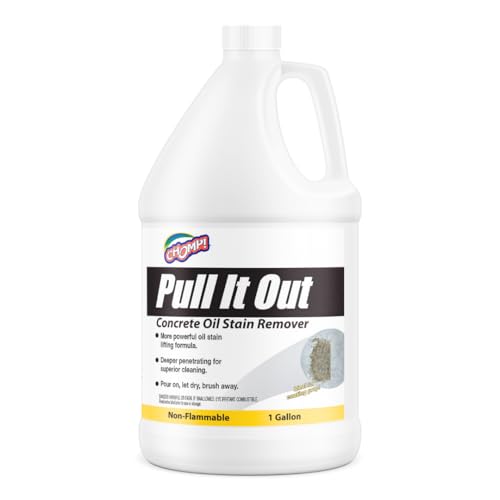
This larger CHOMP! formulation extends the same principles as the 32-ounce version, offering a higher volume option for larger spaces or ongoing maintenance programs. The deep-penetrating formula targets oil and grease on porous surfaces such as concrete and brick, making it suitable for garages, driveways, and industrial floors with recurrent staining. As with the smaller bottle, the product emphasizes safety with no bleach or acid, reducing risk to concrete finishes while delivering stain lift as the formula dries.
Users should plan for a multi-application approach for older or heavier oil deposits. Drying time and dust-like chalk residue are expected outcomes, which can be brushed away to reveal a cleaner surface. Always perform a test spot before applying on expansive stone areas, especially if you have a stone finish that may be sensitive to strong cleaners.
Aqua Mix Poultice Stain Remover

Aqua Mix offers a dual-action poultice stain remover designed for natural stone, combining an absorptive clay paste to draw out deep-set oils and a fine abrasive powder to tackle surface stains and light grout haze. The kit-like approach makes it suitable for professional stone care or DIY renovations where both surface and subsurface oil residues need addressing. The non-acidic formula helps safeguard marble, granite, and other porous materials while seeking to restore uniform appearance.
Typical usage involves applying a paste to the stained area, allowing it to dry, and removing the dried material with minimal scrubbing. The accompanying abrasive powder assists with surface-level staining, offering a two-pronged method to improve stone appearance without aggressive cleaning techniques. For heavier stains, repeat applications may be necessary, especially on older deposits.
Buying Guide: Key Purchase Considerations
When selecting an oil stain remover for natural stone, consider these factors to ensure effective results without compromising stone integrity:
- Stone type and finish: Porous stones (marble, limestone, travertine) are more susceptible to dyeing and etching. Use non-acidic formulations and test on hidden areas first.
- Stain depth and age: Fresh stains are often easier to lift; older, baked-in stains may require multiple applications or a poultice approach.
- Application method: Poultice powders and pastes are generally safer for stone than strong solvents; allow adequate drying time for the paste to draw out contaminants.
- Surface safety: Avoid products with bleach or strong acids on delicate finishes. Look for stone-safe, non-corrosive formulas.
- Volume and coverage: Larger spaces may justify higher-volume products; balance cost with the expected number of applications.
- Maintenance compatibility: Some products work well for spot treatment and routine maintenance, while others are designed for deep stain removal.
For multi-surface projects, combining products can yield optimal results: use a stone-specific remover for initial spot treatments, followed by a poultice powder for deeper penetration in porous areas. Always follow product labels for contact times, protective measures, and rinsing or brushing steps. If uncertain about stone compatibility, consult a stone-care professional to minimize risk of surface damage and ensure long-term appearance is preserved.