Perchloroethylene (PERC) remains a widely used dry cleaning solvent and industrial degreaser due to its strong solvency and textile compatibility. This guide highlights five vetted Alliance Chemical products suitable for dry cleaning, textile processing, metal degreasing, and laboratory grading needs. It targets buyers such as dry-cleaning operators, metal parts manufacturers, automotive and aerospace maintenance teams, and research labs seeking ACS-grade purity. Below is a quick at-a-glance comparison to help you choose the right solvent for your application.
| Product | Best For | Package Size | ACS Grade |
|---|---|---|---|
| Alliance PCE 4 Quart Cans | Dry cleaning and small-scale industrial degreasing | 4 qt | No |
| Alliance PCE 8 Quart Cans | Medium-volume industrial cleaning | 8 qt | No |
| ACS Grade PCE 5 Gallon | Laboratory and large-scale degreasing | 5 gal | Yes |
| Alliance PCE 2 Gallon Cans | Vapor degreasing and textile processing | 2 gal | No |
| ACS Grade PCE 4 x 55 Gallon Drums | Bulk production and manufacturing | 220 gal | Yes |
Alliance Chemical Perchloroethylene PCE 4 Quart Cans

Best for small dry-cleaning setups and light industrial degreasing. This pack of four quarts provides concentrated solvent power suitable for fabric care and metal surface preparation. It’s ideal for shops needing reliable textile cleaning without fabric damage. The product emphasizes strong solvency for oils and greases, making it a practical choice for compact operations.
Who it’s best for: small dry cleaners, hobbyist metal parts cleaners, and labs performing limited-scale prep work. Limitation: not a bulk solution; may require more frequent replenishment for high-demand workloads.
Alliance Chemical Perchloroethylene PCE 8 Quart Cans

This mid-size package supports larger dry-cleaning operations and heavy-duty degreasing tasks. PERC’s high solvency aids in removing oils and greases from fabrics and metal parts, making it suitable for industrial cleaning cycles and textile care facilities. It also serves as a carrier for fabric finishes in some processing lines.
Who it’s best for: mid-volume dry cleaners and manufacturing facilities needing steady solvent supply. Limitation: larger volume requires appropriate storage and handling to prevent evaporation or exposure in workspace.
Alliance Chemical Perchloroethylene ACS Grade 5 Gallon

ACS-grade purity makes this container ideal for lab research, precise chemical synthesis, and high-pidelity metal surface prep where residues must be minimized. It doubles as a robust solvent and degreaser for automotive, aerospace, and manufacturing parts requiring a residue-free finish after cleaning.
Who it’s best for: laboratories and precision manufacturing teams prioritizing analytical-grade solvent purity. Limitation: higher-grade solvent may come with stricter handling and storage requirements for lab environments.
Alliance Chemical Perchloroethylene 2 Gallon Cans

Best for vapor degreasing and textile processing with moderate capacity. This size supports ongoing operations requiring stable supply for fabric finishing and metal part degreasing without committing to bulk storage. The solvent’s dry-cleaning standard underpins effective stain removal on many textiles while protecting delicate fabrics.
Who it’s best for: shops expanding from 4-quart runs to larger cycles without reaching bulk-scale volumes. Limitation: not ideal for very high-volume industrial plants needing continuous replenishment intervals.
ACS Grade Perchloroethylene 4 x 55 Gallon Drums
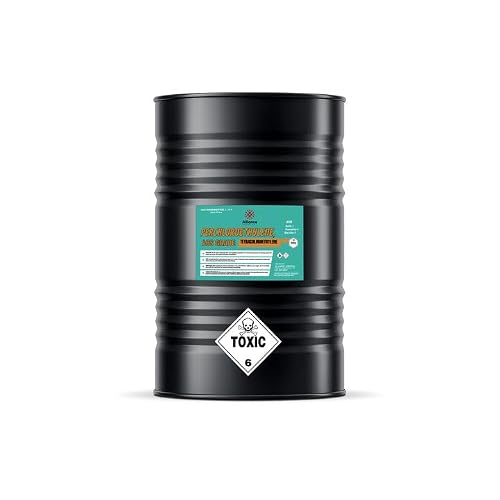
Designed for bulk production and large-scale chemical manufacturing, this bulk pack ensures uninterrupted supply for heavy-duty operations. ACS-grade purity supports rigorous laboratory workflows and large-volume textile processing where consistent solvent quality is essential.
Who it’s best for: large factories, research facilities, and industrial cleaning plants. Caution: bulk storage requires proper containment and ventilation to meet safety standards for volatile solvents.
Buying Guide
- Purity and grade: ACS-grade solvents offer higher analytical purity for labs and precise syntheses. Non-ACS grades are typically suitable for general degreasing and textile cleaning.
- Volume needs: Choose by expected usage. Small shops benefit from 4 qt or 2 gal options; mid-sized operations prefer 8 qt or 5 gal; bulk users should consider 55 gal drums or larger.
- Application type: Dry cleaning, textile processing, metal degreasing, or vapor degreasing each have specific solvent performance needs. Align the product’s stated strengths with your primary use.
- Storage and safety: PERC is a volatile chlorinated solvent. Ensure proper ventilation, containment, and compliance with local regulations. Large-volume purchases require safe handling practices.
- Cost versus value: Consider total cost of ownership, including storage space, disposal requirements, and solvent recovery options if applicable.
- Regulatory considerations: Be aware of regional environmental and occupational safety guidelines governing PERC use in dry cleaning and industrial settings.
Frequently Asked Questions
- What is perchloroethylene used for? It is widely used as a dry-cleaning solvent and as an industrial degreaser for oils and greases on fabrics and metal parts.
- What does ACS Grade mean? ACS Grade indicates high-purity solvent suitable for analytical chemistry, laboratory work, and precision applications.
- Is perchloroethylene safe to handle? It requires proper ventilation, storage, and PPE; follow all safety data and regulations for handling chlorinated solvents.
- Which size is best for a small dry-cleaning shop? A 4-quart or 2-gallon option provides enough supply for typical daily cycles without overwhelming storage needs.
- Can these products be used for vapor degreasing? Yes, some variants are described as suitable for vapor degreasing, depending on equipment and process compatibility.
- Do these products come with warranties? Product details should be checked on the listing; this guide focuses on formulation and intended use rather than assurances.