Answering the common buyer question: which spray-on dry lubricant offers long-lasting, dirt-resistant protection across varied materials and temperatures? This guide highlights five top options and clarifies who each product is best for, so you can pick a dry film lubricant that reduces friction without attracting dust.
Below is a quick summary of the selected products to help you compare at a glance. (Table: product, best use-case, temperature range)
| Product | Best For | Temperature Range |
|---|---|---|
| DuPont Non-Stick Dry-Film Lubricant | Metal-on-metal, precision tolerances | -100°F to +500°F |
| WD-40 Specialist Dry Lube | Blades, tracks, power tools | -50°F to 500°F |
| WD-40 Specialist Silicone Lubrant | Locks, cables, hinges | – |
| 3-IN-ONE RVcare Window & Track Dry Lube | Window tracks, slides | – |
| WEICON PTFE-Spray | Metal, plastic, wood surfaces | -292°F to +482°F |
DuPont Non-Stick Dry-Film Lubricant Aerosol

Brand: DuPont. Features: Unique 100% dry-film Teflon coating and lubricant; clean, long-lasting micro-thin, dirt-resistant coating effective from -100F to +500F; uses proprietary resin-bonding technology for tight tolerance, metal-on-metal applications.
Best for: metal-on-metal applications requiring a clean, durable dry film that resists dirt and performs under extreme temperatures. It’s well-suited for precision components where a thin, residue-free film is essential. Choose this if you need a high-temperature, dirt-resistant coating on machined parts.
Caution: The coating relies on a dry-film chemistry; ensure surfaces are clean before application to maximize adhesion and avoid contamination.
WD-40 Specialist Dry Lube with Smart Straw

Brand: WD-40 Specialist. Features: Dry Lube PTFE spray reduces friction and wear on blades, tracks, drills, lathes, and various equipment; won’t attract dirt or dust; operates from -50°F to 500°F; safe for wood, metal, plastics (with some exceptions). 50-state VOC compliant.
Best for: workshop environments with blades, saws, and moving metal parts that benefit from a clean, non-residual lubricant. This is a strong all-around choice for garage and shop tools where dust load is a concern. Better for general protective use on a variety of surfaces.
Limitation: Some plastics such as polycarbonate may not be compatible; test on non-metal surfaces first if in doubt.
WD-40 Specialist Silicone Lubricant with Smart Straw

Brand: WD-40 Specialist. Features: Silicone-based dry film that leaves a clear, thin protective coating; safe on metal, rubber, vinyl, and plastics; professional-grade formula against natural elements; dries quickly without sticky residue.
Best for: environments where silicone lubrication is ideal—locks, cables, hinges, and guide rails that contact rubber or plastic components. Choose this if you need a silicone film that resists moisture and remains clear for sensitive surfaces.
Limitation: Silicone lubricants can interfere with certain rubber materials over time; verify compatibility with existing seals or gaskets before use.
3-IN-ONE RVcare Window & Track Dry Lube

Brand: 3-IN-ONE. Features: Quick-drying formula leaves a clear protective film to reduce friction; resists dirt and debris in tracks; provides long-lasting corrosion protection against the elements; safe on most materials including vinyl and plastic (except clear polycarbonate and polystyrene).
Best for: RV and home window tracks where a dry-film, debris-repellent lubricant is preferred. Choose this if you are maintaining sliding window mechanisms or door tracks that experience seasonal exposure.
Limitation: Not suitable for all plastics; avoid use on materials sensitive to certain plastics like polycarbonate and polystyrene.
WEICON PTFE-Spray Dry Film Lubricant

Brand: WEICON. Features: Grease-free dry lubricant with PTFE; adheres to metal, plastic, and wooden surfaces; resists dirt, water, and many chemicals; suitable for rails, hinges, and other permanent lubrication tasks.
Best for: multi-surface lubrication where a consistent dry film is needed across metal, plastic, and wood components. Choose this if you want a durable, grease-free film that offers water repellence and chemical resistance.
Limitation: While versatile, testing on delicate finishes is prudent to avoid any surface interaction that could affect appearance or texture.
WD-40 Specialist Silicone, Dry Silicone Lubricant
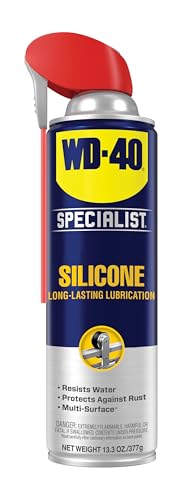
Brand: WD-40 Specialist. Features: Clear, dry silicone lubrication for window tracks, cables, pulleys; reliable performance for moving parts; dries to a clear film without residue; built for auto and equipment use.
Best for: hardware and equipment where a non-staining silicone layer is needed to maintain smooth operation on moving components like tracks, cables, and pulleys. Choose this when you require a silicone-based film with minimal residue.
Limitation: Silicone can interfere with certain plastics over time; test on sensitive components if possible before broader application.
Buying Guide: Key Considerations For Spray-On Dry Lubricants
What should you evaluate before buying? The main factors are film type, surface compatibility, temperature range, viscosity, and residue. Dry films reduce dirt pick-up and often perform better in dusty environments than oily lubricants.
- Film Type: PTFE (Teflon) and silicone are common. PTFE often provides low friction and long wear resistance; silicone offers moisture resistance and clear films.
- Surface Compatibility: Metal, plastic, wood, and rubber surfaces vary in reaction. Always test on a small area if unsure.
- Temperature Range: High-heat environments benefit from coatings rated up to several hundred degrees Fahrenheit.
- Residue: Dry films are preferred when you want no sticky residue. Some products may leave a thin film that remains visible.
- Application Method: Sprays with Smart Straw help target hard-to-reach areas; ensure even coverage and allow drying time.
Practical Decision Tips
- Choose DuPont for precision metal parts and extreme temperatures.
- For general workshop use and multi-surface protection, WD-40 Specialist Dry Lube is a versatile pick.
- For hinges, locks, and plastic-sensitive parts, WD-40 Specialist Silicone or WD-40 Silicone Dry Lubricant provides clear films with easy cleanup.
- For window tracks and sliding mechanisms, 3-IN-ONE RVcare Dry Lube delivers quick-drying protection with debris resistance.
- WEICON PTFE-Spray offers a grease-free option that adheres to multiple substrates and resists various elements.
FAQ
- What is a dry lubricant? A dry lubricant forms a thin, non-residue film that reduces friction between surfaces without leaving a greasy layer.
- Can I use these on plastic parts? Yes, but check compatibility; some plastics may degrade with certain chemical films. Test first on a hidden area.
- Do these sprays attract dirt? Most high-quality dry films are designed to resist dirt, but environment and application surface can influence dirt adhesion.
- Are dry lubricants safe for high-temperature parts? Many options cover wide temperature ranges; always verify the upper limit for your application.
- Is silicone better than PTFE for electronics? Silicone films can be more moisture-resistant, but PTFE generally provides lower friction; choose based on application needs.
- How should I apply these? Shake well, spray from a short distance onto the surface, and wipe away excess if needed. Allow to dry before operation.