Answering the right buying question starts with identifying a reliable vacuum chamber kit that combines a sturdy tank, a strong vacuum pump, and a clear window for monitoring progress. This guide highlights five options that suit hobbyists and professionals seeking efficient degassing, resin stabilization, or wood treatment. Best for resin systems, woodworking, and general degassing, these kits balance capacity, vacuum strength, and build quality. The following table summarizes key specs to help you compare at a glance.
| Product | Chamber Capacity | Vacuum (inHg) | CFM | Brand |
|---|---|---|---|---|
| BACOENG 3 Gallon Tempered Glass Lid Vacuum Chamber with Pump | 3 Gallon | -29.92 | 3.6 | BACOENG |
| BACOENG 5 Gallon 4.5 CFM Tempered Glass Lid Vacuum Chamber with Pump | 5 Gallon | -29.92 | 4.5 | BACOENG |
| VTG VOGTEN 4.5 CFM Vacuum Pump Kit with Gauge | Chamber not specified (kit) | 0-30 inHg (gauge included) | 4.5 | VTG VOGTEN |
| PB Motor Tech 4.5 CFM Vacuum Pump Set & Brass Manifold | Kit (not a single chamber) | Not specified exactly (gauge included) | 4.5 | PB Motor Tech |
| VIVOHOME 7.2CFM Dual Stage Vacuum Pump with Gauge Kit | Kit (vacuum pump with gauges) | 0.2 Pa (approx.) | 7.2 | VIVOHOME |
Note: All prices and availability can change. Values shown reflect the features listed in product descriptions and are used here to help you compare performance and suitability for resin degassing, wood stabilization, or general vacuum processing.
BACOENG 3 Gallon Vacuum Chamber With Pump
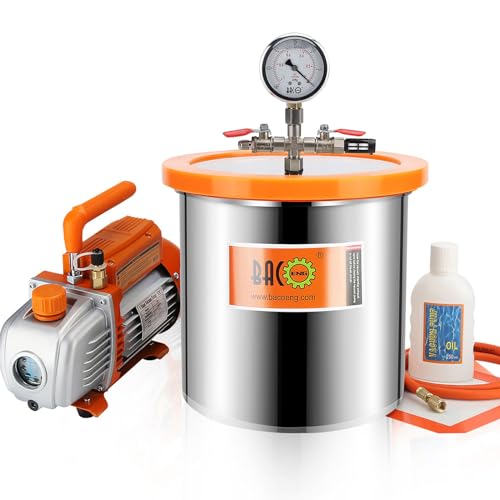
Best for smaller resin projects or hobby use, this kit combines a 3-gallon stainless steel chamber with a tempered glass lid and an integrated vacuum pump. The all-copper motor concentrates power in a compact package, delivering about 3.6 CFM and a vacuum of -29.92 inHg. The tempered glass lid offers clear observation for defoaming progress. Best for: small batches, hobbyists, and delicate materials where visibility is key. Caution: the smaller chamber size may limit throughput for large volumes.
BACOENG 5 Gallon Glass Lid Vacuum Chamber Kit

Choose this for larger resin or wood stabilization tasks. The 5-gallon degassing chamber uses a robust stainless steel body with a silicone gasket rated for extensive reuse. The integrated 4.5 CFM vacuum pump and -29.92 inHg capability provide quicker evacuation and stable, long-duration processing. Best for: medium to large batches, durable builds, and tasks requiring longer dash-time under vacuum. Caution: larger footprint and higher cost compared to 3-gallon variants.
VTG VOGTEN 4.5 CFM Vacuum Pump Kit with Gauge

This kit targets HVAC professionals and serious DIYers who want a full accessory package. It includes a 4.5 CFM vacuum pump, a 4-way manifold gauge, multiple hoses, leak detector, adapters, and a sturdy trifold case for storage. Best for: systems diagnosis, R134a/R410a servicing, and resin work where precise pressure monitoring supports safe degassing. Caution: the kit’s chamber is not included, so you’ll need a separate vacuum chamber if you want a tank-based setup.
PB Motor Tech 4.5 CFM Vacuum Pump Kit & Brass Manifold

This comprehensive diagnostic kit is designed for freon charging and recovery tasks. It includes a 4.5 CFM vacuum pump, a brass manifold gauge with high-quality fittings, multiple color-coded hoses, quick couplers, two can taps, and valve core tools. Best for: professionals who need an all-in-one solution for vacuum, measurement, and charging operations. Caution: published data emphasizes kit components rather than a dedicated tank chamber, so plan a separate chamber if you need a true tank system.
VIVOHOME 7.2CFM Dual Stage Vacuum Pump with Gauge Kit

Best for high-demand degassing and plastics or resin projects needing fast evacuation, this dual-stage 7.2 CFM pump achieves deep vacuum quickly (0.2 Pa vacuum). It sits in a kit with a four-port gauge and multiple adapters for R134a and other refrigerants. Best for: heavier-duty HVAC work, resin defoaming, and systems requiring rapid, deep evacuation. Caution: may be louder than smaller single-stage units and requires adequate space for heat dissipation.
Buying Guide: Key Considerations For Your Tank Vacuum System
- Chamber capacity: Choose 3–5 gallons for most hobbyist projects; larger volumes increase processing throughput but require a bigger workspace.
- Vacuum strength: InHg or Pa values indicate how deeply you can evacuate air. If you’re degassing resins with volatile components, aim for at least -29.92 inHg (or the deepest vacuum the unit supports).
- Pump type and stage: Single-stage pumps are common and economical; dual-stage pumps like the VIVOHOME model provide deeper vacuum faster, suitable for demanding tasks.
- Build quality: Look for copper motor windings, durable stainless steel chambers, and high-quality gaskets that resist wear over thousands of uses.
- Observability: A tempered glass lid helps observe defoaming and cure processes without opening the chamber, reducing contamination risk.
- System integration: If you already own a manifold gauge set or plan to measure refrigerant pressures, ensure compatibility with your hoses and adapters.
- Portability vs. capacity: Smaller setups save space but limit throughput; balance your workspace with your project size and frequency.
- Maintenance: Consider kits with protective filters and easily replaceable seals to minimize oil backflow and leaks.
Frequently Asked Questions
- What size vacuum pump is best for degassing resin? A: For small to medium batches, a 3–5 gallon chamber with 3.6–4.5 CFM can be effective; larger volumes may benefit from 4.5–7.2 CFM pumps.
- Do I need a separate tank if my kit includes a pump and gauge? A: If you want true tank-based degassing, you’ll want a dedicated chamber. Kits without a chamber are great for systems work and resin tasks when you pair them with a chamber.
- Is a dual-stage vacuum pump better than a single-stage for resin work? A: Yes, dual-stage pumps achieve deeper vacuum more quickly and maintain it under load, which is advantageous for long degassing cycles.
- What maintenance is required for vacuum chamber kits? A: Regularly inspect gaskets, keep the chamber clean, replace oil or filters as recommended, and ensure hoses and fittings are leak-free.
- Can these kits handle food-safe or volatile materials? A: Some units specify compatibility with volatile compounds; always confirm material compatibility with the substances you plan to degas and follow safety guidelines.
- How do I observe resin defoaming without opening the lid? A: Choose a kit with a tempered glass lid to monitor progress while maintaining vacuum integrity.