If you’re searching for a floor sweeping solution that reduces labor and speeds up maintenance in warehouses, workshops, garages, or industrial spaces, these models offer strong performance with minimal fuss. This guide highlights five top picks designed for heavy-duty sweeping, easy maneuverability, and reliable dust containment. Best for facilities needing fast coverage, adjustable handling, and low-noise operation, these sweepers help keep large floor areas clear with less back-and-forth.
| Product | Best For |
|---|---|
| KÄRCHER S 4 Twin | Smaller to mid-sized spaces; quiet operation |
| VEVOR Walk-Behind | Budget-friendly, general use |
| KÄRCHER S 6 Twin | Larger areas; higher throughput |
| SANITMAX SM1050A | Large warehouses; high-capacity needs |
| SellEton SL-WS1400 | Ride-on comfort for long shifts |
Kärcher S 4 Twin Walk-Behind Push Sweeper

The S 4 Twin is a human-powered push sweeper designed for efficiency in workshops, garages, and small warehouses. It claims up to five times faster cleaning than a broom, with a wide 26.8″ sweeping path and a 5.25-gallon capacity. The unit operates quietly at 42 dB, reducing noise compared with common blowers. This model is ideal for users who want a broom-free approach without electricity or fuel.
- Best for: Small to mid-sized areas needing fast, manual sweeping with minimal noise.
- Why chosen: Excellent combination of wide coverage, large capacity, and quiet operation.
- Caution: Performance depends on manual pushing effort; not ideal for uneven or rugged surfaces.
VEVOR Walk-Behind Hand Push Floor Sweeper

The VEVOR model offers a 25.6″ sweeping width and a 5-gallon waste container, designed to clean a range of surfaces from smooth floors to slightly uneven terrain. It emphasizes a hands-on, non-electric approach with adjustable features for comfort. The foldable handle aids storage in tight spaces and reduces fatigue during longer cleaning sessions.
- Best for: Budget-conscious shops and facilities needing efficient manual sweeping.
- Why chosen: High-width sweep and compact storage make it versatile for varied layouts.
- Caution: Some users may prefer larger capacity for very large warehouses.
Kärcher S 6 Twin Walk-Behind Push Sweeper

The S 6 Twin increases capacity and sweeping width for larger facilities. It is designed to handle hard floors with powerful side brushes and a wide 33.9″ sweeping path, delivering up to 32,300 square feet per hour. It remains quiet at 42 dB and shares a push-powered, no-fuel design similar to the S 4 Twin, making it suitable for maintenance crews in mid- to large-sized warehouses.
- Best for: Larger warehouses or workshops needing higher throughput.
- Why chosen: Best balance of reach, capacity, and low-noise operation among push sweepers.
- Caution: Larger width may require more storage space and turning radius.
SANITMAX SM1050A Electric Floor Sweeper
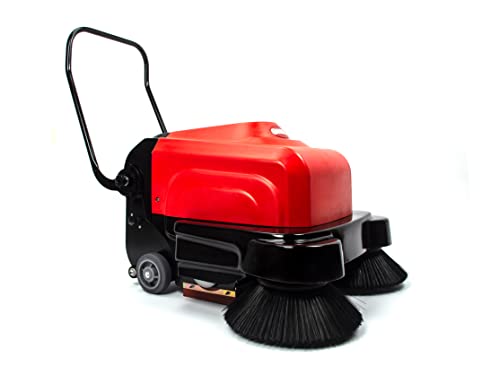
The SM1050A uses an electric drive for smooth operation, featuring a wide 41″ cleaning path suitable for large spaces such as warehouses, schools, and retail floors. It integrates a three-brush system (two side brushes and one main), with a 9.25-gallon hopper for substantial debris collection. The design focuses on efficient dust control and ease of use in busy environments.
- Best for: Large, high-traffic areas needing broad coverage and higher hopper capacity.
- Why chosen: High cleaning path and three-brush system enable fast, thorough sweeps.
- Caution: Electric-powered operation requires access to power sources and may involve more maintenance considerations.
Buying Guide
What surface and space size should guide your pick?
For small workshops and garages, a compact, manually powered sweeper like the S 4 Twin is often ideal due to easy maneuverability and quiet operation. For larger warehouses, models with wider sweeping paths and higher capacities, such as the S 6 Twin or SANITMAX SM1050A, maximize coverage per hour and reduce trips to empty the hopper.
Manual vs electric: which suits your workflow?
Manual sweepers are simple, reliable, and quiet, with no fuel or electricity needed. Electric sweepers offer higher suction and larger debris capacity, suitable for very busy facilities but require access to electrical power and routine maintenance.
Capacity and debris handling: what matters?
Debris hopper size determines how often you need to stop for emptying. In high-traffic areas, choose a model with a larger hopper (e.g., 9.25 gallons) to minimize downtime.
Noise level and operator comfort: how to choose?
Look for sweepers with low decibel levels (around 42 dB) to reduce disruption in busy work environments. Lightweight, adjustable handles and foldable designs improve operator comfort and storage efficiency.
Durability and maintenance considerations
Steel or heavy-duty plastic components improve longevity in industrial use. Consider models with simple maintenance needs and easily replaceable parts like brushes and filters to minimize downtime.
Summary recommendations by use case
- Best for small spaces and quiet operation: Kärcher S 4 Twin
- Best budget option with solid performance: VEVOR Walk-Behind
- Best for large facilities needing high throughput: Kärcher S 6 Twin
- Best for very large, debris-heavy areas: SANITMAX SM1050A
- Best for long shifts and comfort: SellEton SL-WS1400
FAQ
- What is the main difference between push sweepers and ride-on sweepers? A: Push sweepers require manual pushing and are suitable for smaller spaces, while ride-on sweepers allow operators to cover large areas with reduced fatigue.
- Are manual sweepers loud enough to disturb customers? A: Most models listed operate quietly, reducing noise compared with typical industrial tools.
- Can these sweepers handle uneven floors? A: Some models are designed for smooth to mildly uneven surfaces; check individual surface compatibility before purchase.
- How often should I replace brushes or filters? A: Replacement intervals depend on usage and environment; follow manufacturer maintenance guidelines.
- Is an electric sweeper better for warehouses with long shifts? A: Yes, electric sweepers provide higher debris capacity and consistent performance for extended cleaning sessions.