Answering your search for reliable wood dust vacuum systems, this guide highlights five top options tailored to common woodshop needs. Whether you’re a hobbyist, a professional crafter, or a contractor working with sawdust, these picks balance suction power, versatility, and space efficiency. The top picks are best for: compact spaces (wall-mount or small-footprint units), higher CADR for multiple tools, portable setups for mobile workshops, and reliable filtration to extend tool life.
Buying quick-glance table
| Product | Best For | Key Advantage |
|---|---|---|
| WEN DC1300 | Mid-size shops with multiple tools | High airflow with dual inlets |
| WEN DC3474 | Wall-mount convenience | Wall-mount option with solid air flow |
| Dustopper PRO | Maximum separation and filter savings | Low-profile, high separation efficiency |
| Dust Right Wall Mount | Space-saving, multi-tool setups | 650 CFM and easy upgrades |
| OUKEETO Portable Filtration | Portable tabletop or benchtop projects | Adjustable airflow with HEPA filtration |
WEN DC1300 1,300 CFM Dust Collector

The WEN DC1300 is a mid-to-large capacity dust collector designed for shops with multiple tools in use simultaneously. It circulates up to 1,300 cubic feet of air per minute, has dual 4-inch inlets for connecting two tools, and a large 50-gallon collection bag on a mobile base. This setup suits buyers who need a balance of high airflow and mobility in a medium-sized shop.
Best for: medium-to-large woodshops where multiple machines run at once. Better for: users who want to run two tools without swapping connections. Choose this if: you need strong air movement with a straightforward, mobile base. Caution: large capacity can take more space; ensure you have room for the 50-gallon bag.
WEN DC3474 Woodworking Dust Collector

This model uses a 7.4-amp induction motor with a 9-inch impeller, delivering up to 600 CFM. It includes a 4-inch dust port for tool connections and supports optional wall mounting for convenient integration into a compact shop space. It’s ideal for woodworkers who want a wall-mount option without sacrificing airflow.
Best for: shops that prioritize wall-mounting while retaining solid airflow. Better for: spaces where floor footprint matters. Choose this if: you want a mountable solution with decent airflow. Caution: the 600 CFM may be less effective for very high-dust demands in larger spaces.
Dustopper PRO Low-Profile Dust Separator

The Dustopper PRO focuses on maximizing dust separation before the dust enters the vacuum, which reduces filter and bag replacements. It’s a low-profile separator suitable for standard 5-gallon buckets and is designed to deliver high separation efficiency. The system emphasizes reduced ongoing costs and improved ducting compatibility in busy shops.
Best for: buyers seeking high dust separation to cut filter usage. Better for: those who want cost savings on bags and filters. Choose this if: you want to improve suction longevity. Caution: it relies on proper installation to achieve optimal separation performance.
2 in 1 Dust Cyclone Collector (PEMEDOR)

The PEMEDOR 2-in-1 design offers wall-mounted or mobile operation using a cyclone separator with typical 2-inch to 2.5-inch connections. It includes a 5-gallon bucket capacity and a long hose, making it adaptable for small to mid-size workshops that prioritize space savings and portability. The cyclone separator helps keep filters cleaner longer.
Best for: compact spaces needing flexible mounting and mobility. Better for: setups that require a combination of wall-mount and portable use. Choose this if: you want dual installation options. Caution: performance depends on the effectiveness of the cyclone and hose integrity.
Mullet High-Speed Cyclone Dust Collector
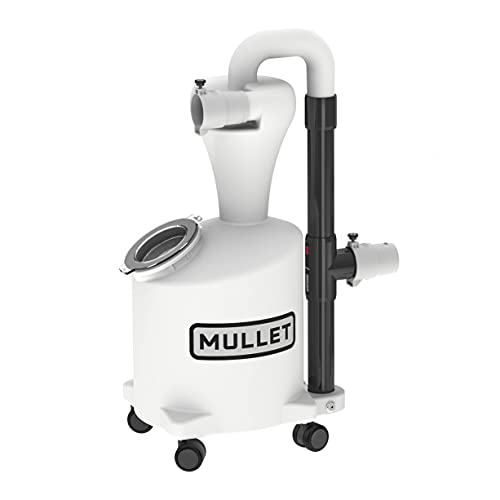
The Mullet cyclone system claims to pre-separate over 99% of debris before reaching a shop vacuum or dust extractor, maintaining strong suction and extending vac life. Its parabolic design aims to increase the airflow velocity and dust capture efficiency, reducing clogs and improving overall dust control for woodworking projects.
Best for: users fighting frequent clogs and filter changes in shop vac setups. Better for: those who want higher pre-separation efficiency. Choose this if: you primarily use a shop vac and need to protect it. Caution: performance depends on compatible vacuums and proper sealing of connections.
Buying Guide
- Shop size and airflow needs: Larger spaces benefit from higher CFM models or systems with dual inlets. Smaller shops can prioritize wall-mount or low-profile options to save space.
- Port size and tool compatibility: Most wood dust systems use 4-inch inlets. Confirm compatibility with your existing tools and ductwork before purchase.
- Mobility vs. fixed installation: Mobile units work well in multi-tool environments, while wall-mount systems save floor space in compact shops.
- Filtration and bag cost: Systems with effective cyclone separation reduce filter and bag replacements, lowering ongoing costs over time.
- Maintenance needs: Look for clear bags, accessible filters, and straightforward disposal to minimize downtime during cleanup.
- Noise level and comfort: Consider noise output if your workspace is near living areas or shared spaces.
- Future expansion: Choose a system with upgrade paths or modular components to accommodate more tools or additional inlets later.
FAQ
- What is the difference between a dust collector and a dust extractor? A dust collector typically uses a cyclone or bag-based system to move air and collect dust, while a dust extractor is usually a portable vacuum designed for spot-cleaning and individual tool use.
- Do I need a cyclone separator? Cyclone separators can significantly reduce filter loading by removing most dust before it reaches the filter, which extends filter life and lowers ongoing costs.
- Can I connect multiple tools to one system? Yes, many models offer dual inlets or multiple ports. Check the product’s inlet configuration and capacity to ensure compatibility with your tools.
- Is wall mounting better than mobile units? Wall-mounting saves floor space and can simplify cable routing in small shops, but you lose some portability.
- What maintenance should I expect? Regularly empty collection bags, clean filters as recommended, and inspect hoses and seals for wear to maintain suction performance.
- Are these systems safe for long-term workshop use? Most units are designed for continuous use in typical woodworking environments; follow manufacturer guidelines for setup and maintenance to ensure safe operation.