If you need reliable OSHA and GHS labeling for spray bottles and other secondary containers, these label rolls help ensure compliance, quick recognition, and safer handling. This guide highlights five options that balance visibility, durability, and ease of use for laboratories, workshops, and homes. The top picks are best for different buyer needs, from budget-friendly roll packs to durable, industrial-grade labels.
Buyer’s quick reference table
- Best overall for balance of visibility and cost: SDS Stickers for Chemical Safety (500 pcs) by Well Tile
- Best for sturdy, industrial-grade durability: SDS OSHA Data Labels 4 x 3 Inches (500 total) by Performore
- Best value per sticker: SDS Label Stickers 4 x 3 Inches (250) by OOOOOSIGNO
- Best for write-in flexibility and NFPA compatibility: SDS Stickers/MSDS Stickers (250) by Well Tile
- Best for high-visibility color coding and quick application: Aleplay SDS OSHA Data Labels 3×4 Inch (100) Roll
Best Safety Labels For Secondary Containers — Well Tile 500 Pcs
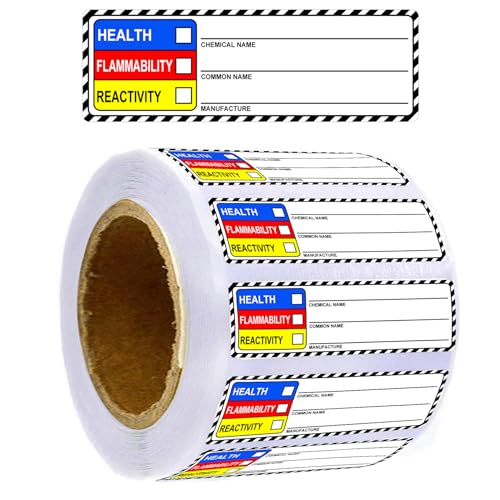
Best for high-volume labeling where space matters. These 1 x 3 inch stickers provide NFPA 704 diamond identifiers and standard GHS pictograms. The roll format encourages quick replenishment and organized labeling on multiple secondary containers. The stickers are ideal for labs, workshops, and commercial environments needing broad coverage without frequent reordering.
Best for: large workplaces that label many spray bottles or secondary containers daily. Choose this if you need simple NFPA-compatible identification with visible color cues and an easy-per-roll supply.
Caution: Smaller label size means limited space for long chemical names or extensive hazard details. Plan ahead to keep a master reference for safety data.
Performore 4 x 3 Inches Labels — Industrial-Grade Durability

These two 250-label rolls (500 total) are pre-printed with standardized pictograms and hazard fields for OSHA and GHS compliance. Made with smudge-proof, chemical-resistant material and a strong adhesive, they’re designed for harsher environments and long-term labeling on secondary containers. Perforated edges enable fast, waste-free tearing and application.
Best for: facilities needing a robust labeling solution that withstands chemical exposure and frequent handling. Choose this if durability and regulatory alignment are priorities.
Limitation: The pre-printed design benefits quick application but may include fields not relevant to every chemical; ensure the labels align with your specific hazard data.
iFioz 4 x 3 Inches SDS Labels — Quick, Clean Perforation

These 4 x 3 inch labels provide a comprehensive GHS and HMIS-compliant labeling solution for secondary containers. Perforated edges allow quick, clean removal for daily labeling tasks, making them suitable for shops and laboratories with frequent updates to chemical inventories.
Best for: environments requiring straightforward, compliant labeling with easy removal to minimize waste. Choose this if you value quick application without sacrificing hazard clarity.
Limitation: The data focuses on compliance features; check whether the exact pictogram set matches your internal safety data requirements before broad deployment.
OOOOSIGNO SDS Stickers 4 x 3 Inches — Clear Perforation
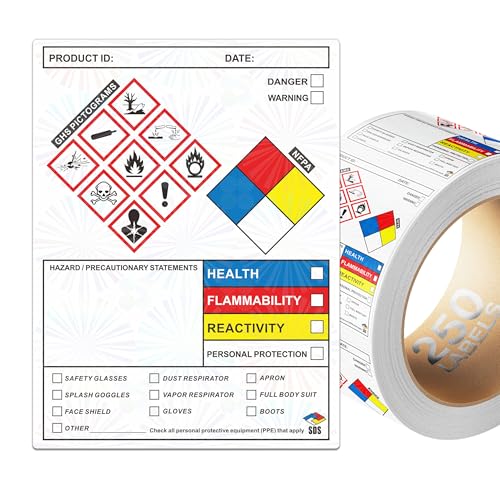
This 250-label roll emphasizes safety with vivid colors and complete GHS pictograms plus HMIS aspects. The roll format and perforated design streamline labeling on multiple spray bottles or secondary containers, making it a practical choice for busy work areas.
Best for: buyers who want a reliable, clear, color-coded labeling system without a large upfront commitment. Choose this for steady, ongoing labeling needs.
Limitation: Some users may need additional space for longer chemical names; consider pairing with a reference sheet for full hazard details.
Well Tile 1 x 3 Inches — NFPA And Labeling Details

These 1 x 3 inch stickers focus on NFPA 704 diamond identifiers with standard permanent adhesive and an easy-to-peel backing. The compact size supports labeling on narrow spray bottles or smaller secondary containers while maintaining visibility through bold color contrast.
Best for: projects where space is at a premium but hazmat codes must still be conveyed. Avoid this if you require extensive hazard narratives on each label.
Aleplay 3 x 4 Inch OSHA Data Labels — High Visibility

This 100-label roll features bright safety colors with enough space to write chemical names and quick hazard identifiers. The semi-gloss surface offers durability in typical lab or shop environments, ensuring legibility over time.
Best for: smaller teams or temporary labeling tasks where quick, visible labeling is needed without a heavy ongoing supply. Choose this if you prioritize immediate visibility and simple text entries.
Limitation: Fewer labels per roll mean more frequent reorders for larger facilities; plan accordingly to avoid gaps in labeling coverage.
Buying Guide: Key Considerations For Spray Bottle Labels
- Compliance scope: Ensure labels meet OSHA Hazard Communication standards and GHS pictogram requirements relevant to your operations. Look for HMIS and NFPA compatibility where needed.
- Size and content: Choose label dimensions that provide adequate space for chemical name, hazard statements, and pictograms. Smaller labels save space but limit detail; larger labels improve readability but may not fit every bottle.
- Durability: For spray bottles and chemical containers, prioritize chemical-resistant materials and strong adhesives. Consider environmental exposure, including humidity, splashes, and temperature changes.
- Perforated vs. solid labels: Perforated edges aid quick separation and daily replacement. Perforation suitability depends on how often you re-label containers.
- Color coding and visibility: High-contrast color schemes (red, blue, yellow) help quick hazard recognition. Ensure you have a consistent color scheme across all containers.
- Write-in flexibility: Some labels provide space for writing the chemical name or common name. If your inventory changes often, consider labels with more writable area or a digital cross-reference system.
- Application use: Evaluate whether labels will be applied to glass, plastic, or metal containers. Some adhesives adhere better to certain surfaces, and wet or oily residues can affect adhesion.
- Bulk needs and reordering: For large facilities, rolls with 250–500 labels help maintain supply continuity. Smaller teams may prefer cost-efficient, smaller packs.
FAQ
- Q: Are these labels compliant with OSHA and GHS?
A: Each option advertises GHS pictograms and HMIS/OSHA elements designed for regulatory compliance in typical workplace settings. Always verify against current OSHA and GHS guidelines for your specific industry. - Q: What is the best label size for spray bottles?
A: 3 x 4 inches or 4 x 3 inches balance readability with available space on many spray bottles. If space is limited, 1 x 3 inch labels can work for brief identifiers. - Q: Do these labels resist chemical exposure?
A: Several options cite chemical-resistant materials and smudge-proof finishes. For high-splash environments, prioritize labels with durable adhesives and chemical resistance. - Q: Is perforation important for daily labeling tasks?
A: Perforated edges facilitate quick removal and replacement, reducing waste and effort in daily workflows. - Q: How should I organize label usage across a facility?
A: Adopt a consistent labeling scheme (color codes, pictograms, and hazard statements). Keep a master reference sheet and map every container to its label, ensuring easy cross-reference during inspections. - Q: Can labels be reused if a bottle is refilled?
A: In most cases, labels are designed for one-time use. If you frequently repurpose bottles, look for removable or easy-to-overlabel options and maintain a centralized inventory log.